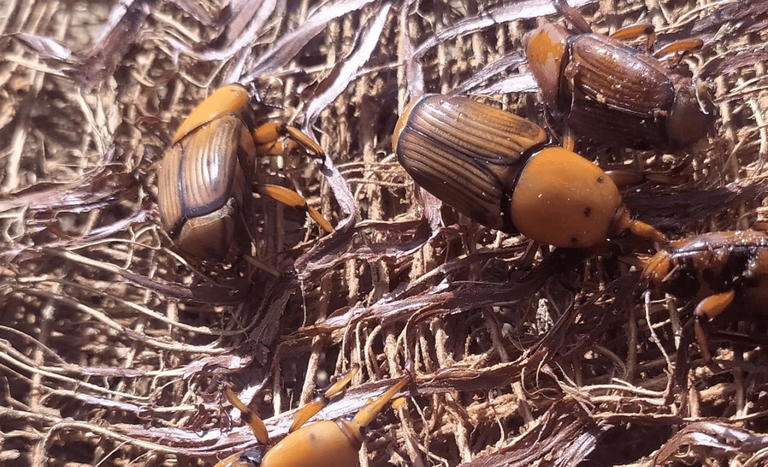
The Brazilian Ministry of Agriculture and Livestock (MAPA) has intensified surveillance and prevention efforts against the red palm weevil (Rhynchophorus ferrugineus), a quarantine pest absent in Brazil but already registered in neighboring countries such as Uruguay and Argentina. This geographical proximity raises concerns about the risk of its introduction into the national territory, mainly through the irregular transit of seedlings and host plants. Prevention is the most effective and economical measure to avoid the entry and spread of the pest. Therefore, MAPA advises producers, traders, landscapers, and the general public on the importance of acquiring plants only from regulated suppliers with phytosanitary certification, and not transporting seedlings of unknown origin, especially in border areas. The red palm weevil is a highly destructive beetle that attacks various palm species, including coconut, oil palm, and ornamental plants. The damage is mainly caused by the larvae, which develop inside the plant, making early detection and control difficult. In advanced infestations, the pest can cause crown collapse and plant death. Warning and identification signs include holes in the trunk exuding sap or chewed fibers; a foul odor emanating from the plant; yellowing and shedding of central leaves; and crown deformation, which can become flattened in advanced stages. The red palm weevil can be confused with the coconut palm weevil (Rhynchophorus palmarum), a species already present in Brazil. Therefore, confirmation must be carried out by professionals from the Ministry of Agriculture, Livestock and Supply (MAPA) or by the State Plant Health Defense Agencies (OEDSV). Potential impacts include significant economic losses to coconut and oil palm production and the ornamental sector; death of palm trees of high economic and landscape value in urban and rural areas; potential for rapid dissemination due to the transit of seedlings; and environmental and landscape impacts. Given this scenario, the Ministry of Agriculture, Livestock and Supply (MAPA) has been adopting preventive measures, such as strengthening phytosanitary surveillance at borders and points of entry into the country, in addition to training technical teams and disseminating alerts and informational materials. Public participation is fundamental in combating the pest. In case of suspicion, the advice is not to handle or transport the material and to immediately notify the Superintendence of Agriculture and Livestock (SFA/MAPA) or the state plant health defense agency of your state. Information can also be sent to the email address alertapragas@agro.gov.br. MAPA emphasizes that the protection of agriculture and the environment depends on joint action between the public authorities and society, with information and prevention being essential to keep Brazil free from the red palm weevil.
This text was translated by machine from Brazilian Portuguese.