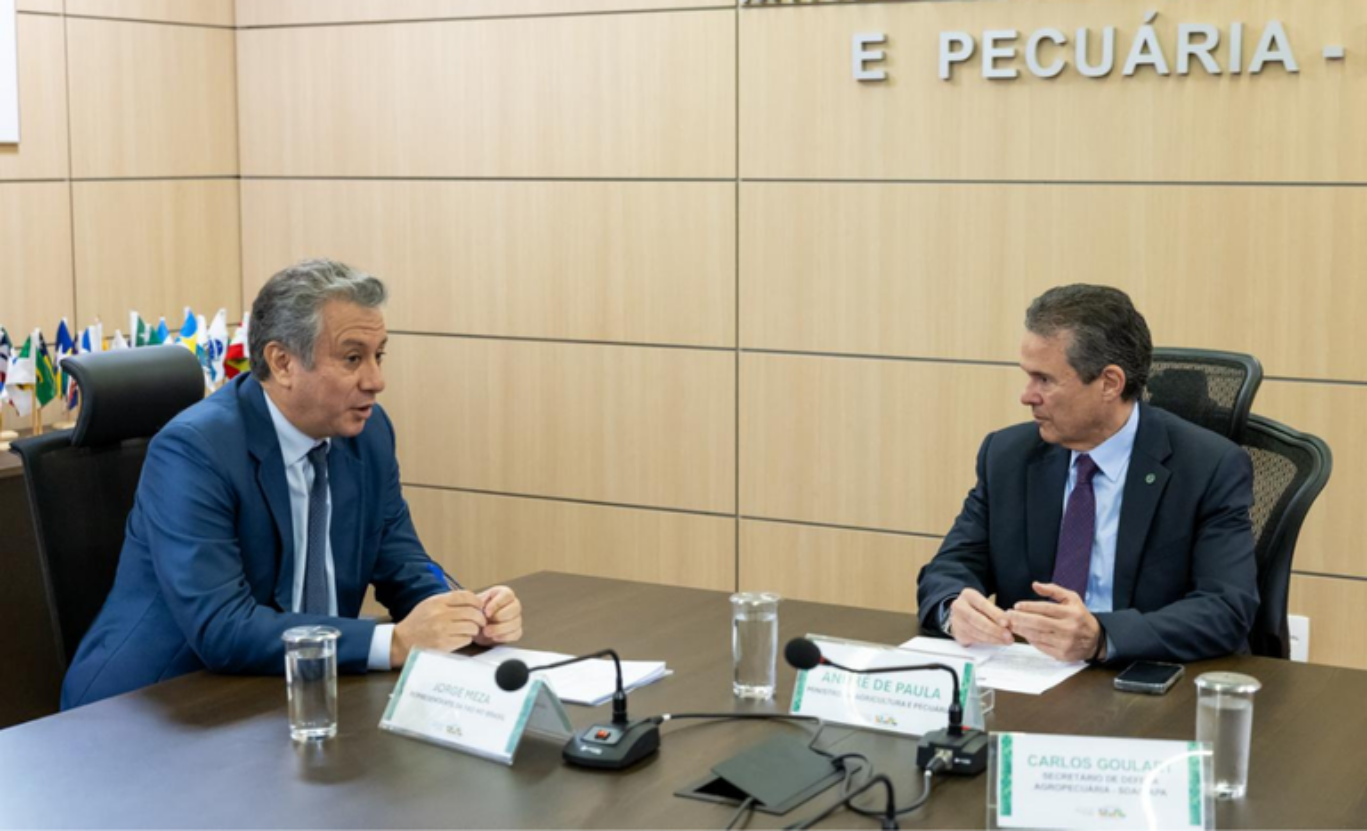
On Monday (15), the Minister of Agriculture and Livestock, André de Paula, received the representative of the Food and Agriculture Organization of the United Nations (FAO) in Brazil, Jorge Meza, to discuss strengthening cooperation between the Ministry of Agriculture and Livestock (Mapa) and the organization on strategic issues for agriculture, food security and sustainable development. During the meeting, the minister stressed the relevance of the partnership between Brazil and FAO and highlighted the Brazilian contribution to the advancement of initiatives aimed at sustainable food production, adaptation to climate change and strengthening agricultural defense. Among the topics discussed was the cooperation between FAO and the Brazilian Agricultural Research Corporation (Embrapa), linked to Mapa. In March 2026, the institutions signed a new Memorandum of Understanding to expand joint action in science, innovation and public policies aimed at the sustainable transformation of agri-food systems. The agreement covers areas such as food and nutritional security, sustainable agricultural development, climate action, biodiversity, bioeconomy, circular economy, and technical capacity building. The international recognition of Embrapa as a benchmark in tropical agriculture was also highlighted. Through the institution, Brazil shares technologies and experiences in the recovery of degraded areas, integrated crop-livestock-forestry systems (ILPF), low-carbon agriculture, and adaptation to climate change, contributing to increased productivity and sustainability of agriculture in different regions of the world. Another point discussed at the meeting was the historical cooperation between the FAO and the National Institute of Meteorology (Inmet). The institutions work together on initiatives related to agrometeorology, climate monitoring, early warning systems for droughts and extreme events, and strengthening the resilience of production systems.
Agricultural Defense
Agricultural and livestock defense was among the central themes of the meeting. In this context, Brazil's participation in the prevention, monitoring, and control of transboundary animal diseases was highlighted. As the national veterinary authority, the Ministry of Agriculture, Livestock and Supply (MAPA) plays a strategic role in the international monitoring of diseases, in strengthening mechanisms for prevention and response to sanitary emergencies, and in disseminating good biosecurity and risk management practices. Minister André de Paula also emphasized the international recognition achieved by Brazil due to the robustness of its agricultural and livestock defense system. The coordinated action of MAPA and state agencies in addressing highly pathogenic avian influenza (HPAI) in 2025 demonstrated the country's technical and operational capacity to rapidly detect, contain, and eradicate sanitary emergencies, preserving the integrity of the national poultry stock and the credibility of Brazilian sanitary controls. In the area of plant health, the meeting addressed actions related to cassava witches' broom disease, a quarantine pest caused by the fungus Rhizoctonia theobromae and first identified in Brazil in 2024. The integrated work between the Ministry of Agriculture, Livestock and Supply (MAPA), Embrapa, and international organizations has contributed to strengthening phytosanitary surveillance, developing monitoring and containment protocols, and expanding research focused on controlling the disease. The Secretary of Agricultural Defense, Carlos Goulart, highlighted the importance of international cooperation in tackling the problem. "At this moment, it is fundamental to expand efforts aimed at controlling the pest and developing technological solutions. Embrapa has already received resources allocated to the development of cultivars with greater resistance to the disease," he stated.
REGIONAL COOPERATION FOR CLIMATE ACTION
Another topic discussed was Brazil's role in the Latin American and Caribbean Platform for Climate Action in Agriculture (PLACA), of which the country holds the co-presidency for the 2025-2026 biennium, alongside Peru. With the FAO as technical secretariat, the initiative promotes regional cooperation in adaptation to climate change, emissions mitigation, public policy development, and technical capacity building. The Deputy Secretary of Trade and International Relations, Augusto Billi, highlighted the close institutional relationship between Brazil and the FAO. “The Ministry of Agriculture maintains a permanent position as agricultural attaché to the Brazilian representation at the FAO, based in Rome. Brazil works side-by-side with the organization in building solutions to the challenges of global agriculture,” he stated. Also participating in the meeting were the FAO's Deputy Representative in Brazil, Gustavo Chianca; the coordinator of the FAO's Technical Area for Better Environment in Brazil, Felipe Stock Vieira; and the head of the Special Advisory Office for Social Communication of the Ministry of Agriculture, Carla Madeira. The partnership between the Ministry of Agriculture and Livestock and the FAO reinforces Brazil's role as an international benchmark in food security, agricultural defense, innovation, and sustainability.
This text was translated by machine from Brazilian Portuguese.