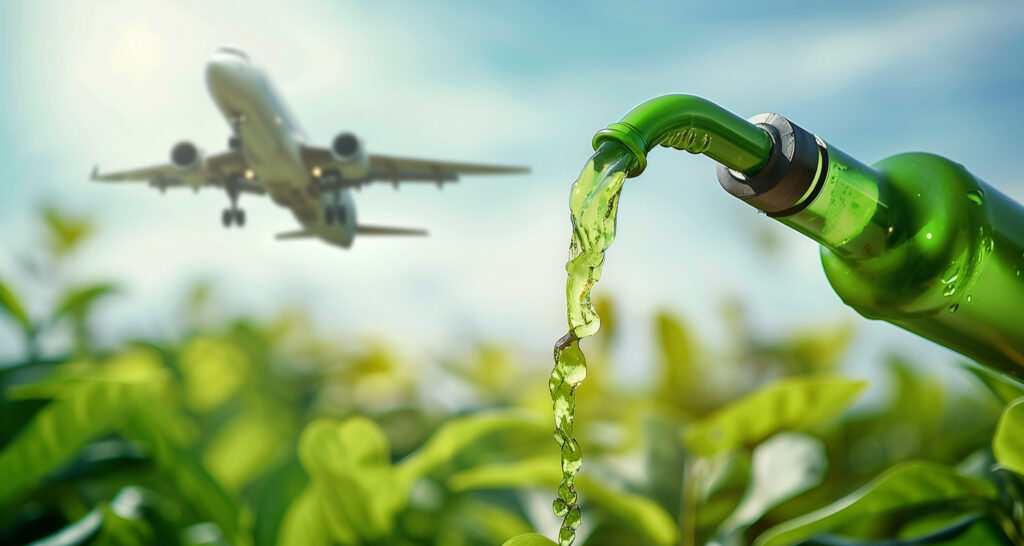
The so-called SAF Decree, which will dictate the rules for airlines' efforts to reduce carbon dioxide (CO₂) emissions, is "about to be published," said Lorena Mendes de Souza, general coordinator of Biodiesel and Other Biofuels at the Ministry of Mines and Energy (MME), this Wednesday (17). SAF is the acronym for Sustainable Aviation Fuel, pointed out as the main path to decarbonizing the aviation sector, says a note from "Agência Brasil". The decree aims to regulate the Future Fuel Law (Law 14.993/2024), which outlines routes for the energy transition in the country, reducing the emission of greenhouse gases – such as CO₂ – that cause global warming and, consequently, climate change. “I take this opportunity to announce in advance that the SAF Decree is about to be published; it is currently at the Ministry of the Civil House of the Presidency of the Republic, awaiting final procedures,” revealed Lorena Souza. “With this publication, we can take a very important step for this public policy, for the predictability of investments in biorefining in Brazil,” she added. The statements were made during the IBP Forum – SAF Brazil 2026 event, promoted in Rio de Janeiro by the Brazilian Institute of Petroleum, Gas and Biofuels (IBP), which represents companies in the sector. She participated via videoconference.
Fuel of the future
The Future Fuel Law established the National Sustainable Aviation Fuel Program (ProBioQAV), a set of policies that encourages research, production, marketing, and energy use of SAF (Sustainable Aviation Fuel). SAF is a mixture of aviation kerosene with renewable raw materials, such as vegetable oils, animal fat, or ethanol from sugarcane or corn. This mixture allows for a reduction of up to 80% in greenhouse gas emissions associated with the fuel. One of the program's goals is that, starting in 2027, airlines will reduce greenhouse gas emissions by 1%. The degree of reduction is phased in, so that the sector reaches a 10% reduction in emissions by 2037. Internationally, the International Civil Aviation Organization (ICAO) has set a goal of emissions neutrality by 2050, meaning sequestering or offsetting the amount of gases emitted. According to the executive director of Downstream (the final flow of a process) at IBP, Carlos Orlando Enrique da Silva, SAF is the "product that appears most relevant to address this energy transition." The International Air Transport Association (IATA) estimates that 65% of emission reductions by 2050 will be achieved through SAF. According to IATA's manager for Brazil, Simone Warmbrand, in 2026, global SAF production will reach 2.4 million tons, representing 0.8% of global aviation fuel use.
Interested parties are waiting.
The SAF Decree is eagerly awaited by producers, the aviation sector, and federal regulatory agencies as a way to unlock fuel production and demand in the country. Priscilla Vieira, a SAF specialist advisor at the National Civil Aviation Agency (ANAC), expressed anticipation for the decree's publication, which will outline ANAC's role as regulator of SAF use by airlines. "ANAC is working against the clock. Everything depends on the signing and publication of the decree. We expect it to be released this week," she stated. She anticipated that the decree will present points such as the obligations and rights of producers, importers, blending agents, and air operators. ANAC needs the publication to regulate the text. Another regulatory agency awaiting the SAF Decree is the National Agency of Petroleum, Natural Gas and Biofuels (ANP), linked to the Ministry of Mines and Energy (MME). "There are some questions that I am waiting for the decree to clarify," said Maria Auxiliadora de Arruda Nobre, Deputy Superintendent of Technology and Environment at ANP. She stated that ANP will be responsible for issues such as regulating fuel quality, ensuring operational safety, and the methodology for calculating flight emissions. The superintendent reinforced the view that SAF (Surface Availability) is the path to energy transition in the air, unlike the automotive industry, where electrification is seen as promising. [Photo caption: ANAC advisor Priscilla Vieira and ANP deputy superintendent for technology and environment, Auxiliadora Nobre, during the IBP Forum – SAF Brazil 2026. Photo: Tomaz Silva/Agência Brasil]
Petrobras
In Brazil, Petrobras is the main producer and supplier of SAF (Steel-Asphalt Financing), representing 92% of all fuel currently sold. The company's SAF is produced at the Duque de Caxias Refinery (Reduc) in Rio de Janeiro, but there are plans to extend this to other units. William Vella Nozaki, Petrobras' Executive Manager of Integrated Energy Transition Management, participated in the meeting and conveyed a message from the company's president, Magda Chambriard. "She told me: 'like the entire aviation and energy sector, we are eager for the publication of the decree'," he recounted. Companies from the agricultural and energy sectors participated in the meeting, such as Raízen (ethanol), Bugen (agribusiness), and Vibra (distributor). Nozaki added that Chambriard assured him that "whatever the text of the decree, we will be together in the search for a solution that involves pathways to traceability, certification, and efficiency in both pricing and fiscal matters, so that this energy transition alternative is also an alternative for energy security for the country." Besides Petrobras, another company seeking to produce SAF is Acelen Renováveis, from the private group that already owns the Mataripe refinery (formerly Landulpho Alves), in São Francisco do Conde, Bahia. Acelen will develop SAF from macaúba, a native Brazilian plant adapted to the Cerrado biome.
Price
One of the concerns with sustainable aviation fuel is its cost, which is higher than traditional fossil aviation kerosene. ANAC advisor Priscilla Vieira believes that the Future Fuel Law could create demand, making the final price of SAF (Sustainable Aviation Fuel) more accessible. "It created demand to bring predictability to fuel producers. Producers will invest, they will bring investment from the financial market to be able to start producing," she said. "The supply comes in, the demand pressure drops a little, so the price might settle down a bit, lower than what we have today, with very high demand pressure," she concluded.
This text was translated by machine from Brazilian Portuguese.