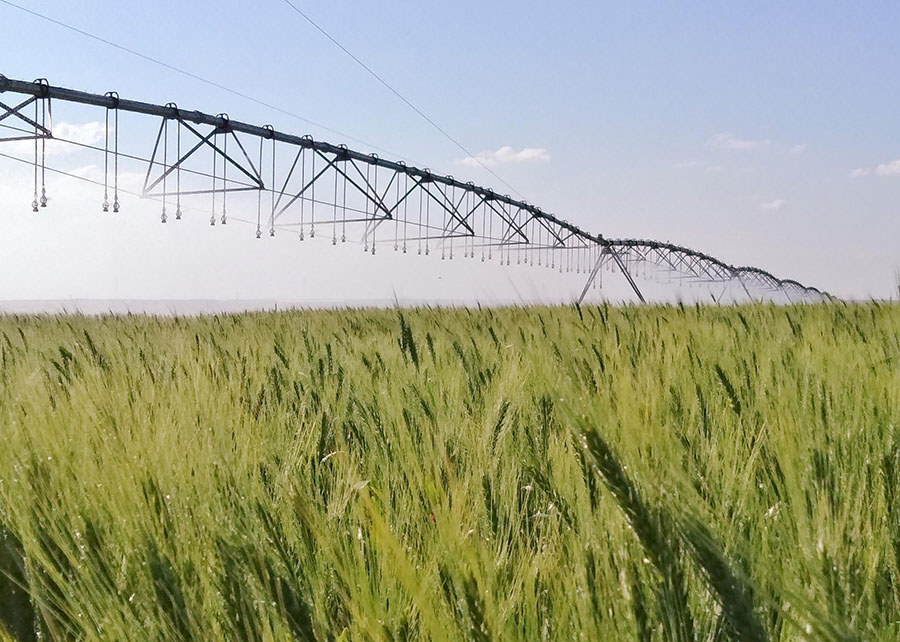
A groundbreaking study conducted by ABIMAQ (Brazilian Association of Machinery and Equipment Industries) in partnership with GPP/USP/ESALQ (Public Policy Group of the University of São Paulo, Luiz de Queiroz School of Agriculture), reveals that the expansion of irrigated agriculture in irrigation hubs in Bahia, Minas Gerais, Mato Grosso, and Rio Grande do Sul can increase the average productivity of temporary crops, generate jobs in rural areas, and increase the gross added value of agriculture. These results are part of a broader study, which will be officially launched at the end of May. A study by ANA (National Water and Basic Sanitation Agency)[1] identified areas equipped for irrigation of 8.2 million hectares, which could grow more than five times with the incorporation of 55.85 million hectares, approximately 48% of which are occupied by pastures. “With robust evidence and measurable impact, the study indicates that irrigated agriculture tends to gain even more importance in the face of climatic and productive challenges, increasing efficiency in the field and contributing to reducing regional inequalities. The assessment is that, with adequate public policies and planning, the technology can gain scale in the country and help producers produce more safely, even in the face of climatic variations,” says Luiz Paulo Heimpel, Vice-President of CSEI (Sectoral Chamber of Irrigation Equipment of ABIMAQ). The study analyzed seven regional centers with a strong presence of irrigation. The results show that irrigation centers offer significantly higher remuneration than other rural municipalities. In Bahia, for example, incomes are, on average, 68.6% higher. In Minas Gerais, the gain reaches 42.85%, while in Rio Grande do Sul and Mato Grosso the increases are 11.96% and 8.13%, respectively. Beyond income, the differences in development among irrigation hubs extend to quality of life. Irrigated areas show less dependence on income transfer programs. In Mato Grosso, for example, the percentage of beneficiaries is about 50% lower compared to other rural municipalities. In the economic field, the GDP per capita of irrigation hubs is up to 256% higher than that recorded in other rural municipalities. In Mato Grosso, this value exceeds R$ 182,000, one of the highest levels observed in the study. Direct impact on the economy Simulations indicate that the expansion of irrigation in the analyzed hubs generates immediate and lasting effects. Each incorporation of 1,600 irrigated hectares can increase the gross added value of agriculture by R$ 8.27 million in the short term, generating formal jobs. In the long term, this impact can reach almost R$ 14 million. Strategic agenda Despite the potential, the advancement of irrigation in Brazil depends on a coordinated agenda of public policies and private action. The study points to four pillars to enable this expansion: 1 – Access to competitive energy; 2 – Training of a qualified workforce; 3 – Efficient management of water resources; 4 – Increased connectivity in rural areas. According to the researchers, irrigation should be treated as a structuring component of the country's agricultural policy and food security strategy. "Irrigation brings predictability for the producer, reduces risks, and improves productivity. The data shows that its effects go beyond production, with a direct impact on income and the development of regions," concludes Luiz Paulo Heimpel.
This text was translated by machine from Brazilian Portuguese.