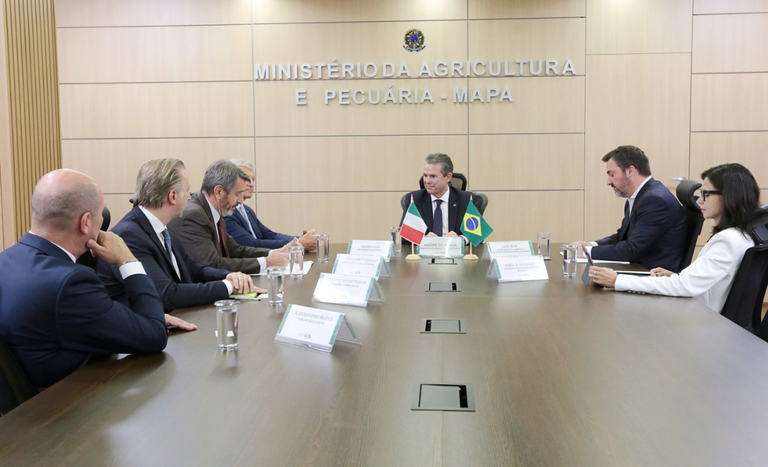
The Minister of Agriculture and Livestock, André de Paula, received, this Wednesday (6), the president of the Italian coffee company Illycaffè, Andrea Illy, and the Italian ambassador to Brazil, Alessandro Cortese. The meeting aimed to discuss topics related to the coffee production chain, bilateral trade and technical cooperation. During the meeting, Minister André de Paula stressed that the reestablishment of good relations with partner countries, such as Italy, is a priority for the Brazilian government. “The construction of balanced partnerships, both in opening markets for Brazilian products and in receiving foreign products, must consider the interests of both parties. So, it seems to me that we have a perfect relationship here,” he said. In his speech, Ambassador Alessandro Cortese highlighted that the promotion of industries and companies is a priority for the Italian government. “We are in a very productive phase. Since May 1st, the agreement between Mercosur and the European Union has been in effect. Working together, we can move forward more easily on commercial issues in the agricultural area of Italian and Brazilian interest,” he stated. Another issue raised by the ambassador was the Italian government's interest in transferring the headquarters of the International Coffee Organization (ICO) to Rome, considering its proximity to other international organizations based in the city, such as the Food and Agriculture Organization of the United Nations (FAO) and the International Fund for Agricultural Development (IFAD), which could favor the convergence of agendas on topics such as sustainability, rural development, and support for producers. The president of Illycaffè, Andrea Illy, highlighted Brazil's importance as the company's main supplier of Arabica coffee, emphasizing the country's role in global production. “Brazil represents over 40% of the world's coffee production, and in particular, the state of Minas Gerais. We are recognized as world leaders in quality, not quantity. We focus specifically on the best export quality, and Brazil is our largest supplier, always continuing to improve and grow. It's a direct purchase business model,” he said. He added that the company adopts an integrated strategy in Brazil based on the promotion of regenerative agriculture, continuous training of producers, and incentives for quality. “We maintain ongoing technical training programs for producers in Brazil, covering everything from agricultural management to farm management and monitoring of environmental indicators. The logic is to align productivity, quality, and sustainability, offering, in return, differentiated remuneration to producers who achieve superior standards,” he stated. The Secretary of Trade and International Relations of the Ministry of Agriculture, Luís Rua, highlighted that the agreement between Mercosur and the European Union can also expand opportunities for companies with a global presence and a significant presence in the Brazilian market, especially in the segments of inputs, machinery, and coffee capsules, which should undergo gradual tariff reductions until 2034. The meeting also discussed the challenges faced by the coffee sector due to climate change. On that occasion, Secretary Rua presented the programs developed by the Ministry of Agriculture, such as the ABC+ Plan, the main public policy aimed at promoting low-carbon agriculture, which encourages the adoption of sustainable technologies to increase productivity while conserving the environment. The Caminho Verde Brasil program was also highlighted, an initiative focused on recovering up to 40 million hectares of degraded areas, aiming to expand agricultural production sustainably without needing to expand into new areas. Another point discussed was the expansion of international cooperation for the transfer of Brazilian technical knowledge. In this context, the special advisor to the Ministry of Agriculture, Sibelle Andrade, emphasized the role of Embrapa. “Linked to the Ministry of Agriculture, Embrapa has a specialized coffee unit based in Brasília. In partnership with Embrapa and other strategic actors, the Ministry of Agriculture can strengthen cooperation with international organizations, such as the FAO and the Inter-American Institute for Cooperation on Agriculture (IICA), to expand the dissemination of Brazilian knowledge in regenerative agriculture,” she stated. She added that a large part of the actions related to low-carbon agriculture are developed within Embrapa, focusing on both the generation and dissemination of best practices. According to the advisor, there is an opportunity to structure partnerships that enable resources for research and expand the transfer of Brazilian knowledge, especially to smaller producers in other countries. Also participating in the meeting were the Minister-Counselor of the Italian Embassy, Federico Ciattaglia, and the director of Illycaffè, Alessandro Bucci.
This text was translated by machine from Brazilian Portuguese.