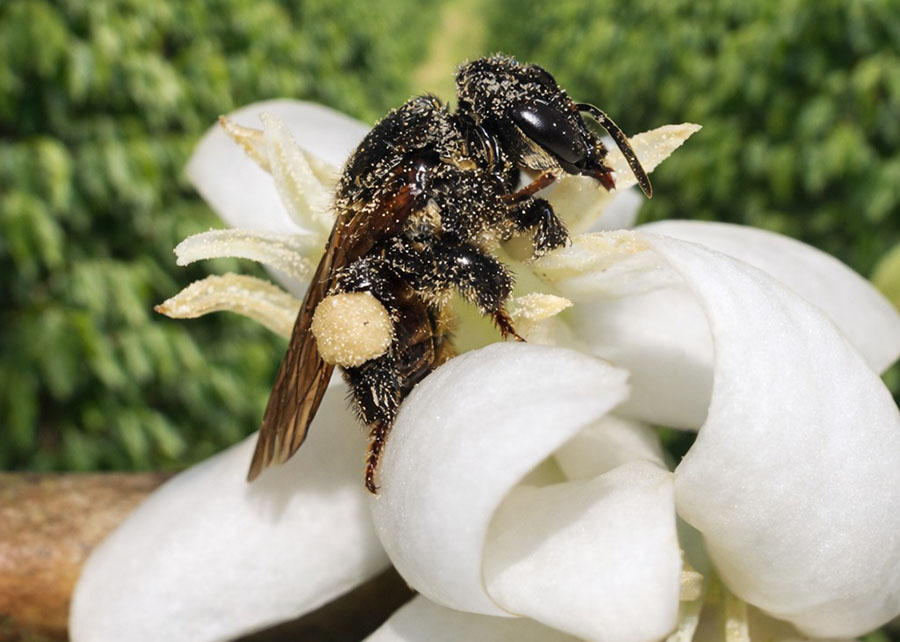
A study conducted by Embrapa Meio Ambiente (SP) and partner institutions shows that managing native stingless bees can increase the production of Arabica coffee fruits by up to 67%. Published in the scientific journal Frontiers in Bee Science, the research highlights the potential of managed pollination as a strategy to increase productivity and strengthen the sustainability of coffee farming. The study evaluated the effect of supplemental pollination carried out by Scaptotrigona depilis, known as the mandaguari bee. A social species of the meliponine group, it occurs in different regions of Brazil. The increase of up to 67% in fruit production on branches located near the colonies reinforces the efficiency of the mandaguari as a coffee pollinator, including in self-compatible cultivars, that is, varieties capable of self-pollination. To measure this effect, the researchers installed colonies on conventional farms, at an approximate density of ten colonies per hectare, before the start of flowering. Production was compared between branches near the colonies and branches further away, which allowed us to associate the increase in yield with bee activity.
Complementary research
The results showing increased Arabica coffee production with the mandaguari bee are part of a broader line of research on the relationship between coffee and pollinators in Brazil, initiated in 2021 in commercial plantations in São Paulo and Minas Gerais, under real field conditions. The data corroborate a previous study that estimated a potential gain of R$ 22 billion per year from pollination (read the article). These complementary studies are part of a joint effort between scientific institutions and public companies to address challenges in coffee farming, such as phytosanitary management, biodiversity conservation, and increasing the productivity and quality of the beans.
Differential
The study with the mandaguari cactus offers, as a distinguishing feature, unprecedented data on the interaction between chemical inputs and native pollinators in controlled environments, with direct effects on production. For the researchers, the results are preliminary and indicate that the potential of pollinators in Brazilian coffee farming may be even greater. The national and international scientific collaboration network behind the study is formed by Embrapa Meio Ambiente, Escola Superior de Agricultura Luiz de Queiroz (Esalq/USP), Universidade Federal do Rio Grande do Sul (UFRGS), Natural England, and Eurofins Agroscience Services. The research also received support and funding from Syngenta.
Colony health
In addition to its effect on productivity, the researchers investigated whether the use of neonicotinoid insecticides could affect the health of the colonies. The focus was on thiamethoxam, used in previous harvests in conventional areas. During the follow-up, the researchers monitored indicators such as brood production, brood mortality, and the activity of collecting food and materials used in the construction of the internal structures of their nests. The evaluations took place at different times: one week before flowering; one week immediately after flowering; and approximately 45, 75, and 105 days after harvesting from the coffee plot. The team also measured residues of the insecticide and its metabolite, clothianidin, in materials collected in the field, such as coffee leaves, nectar, and pollen. The detection confirmed that the use of neonicotinoids left residues in floral resources accessible to pollinators. Despite this, no statistically significant impacts were observed on the parameters evaluated in the colonies. Indicators such as brood production and mortality did not show significant differences between colonies established in conventional areas and those maintained on organic farms after the exposure period. Collection activity showed initial variations between the systems, but these differences decreased throughout the monitoring period.
Study points to compatibility between pollination and phytosanitary management.
The authors highlight two central implications for coffee farming. The first is that stingless bees can act as effective pollinators of Arabica coffee, with the potential to increase productivity even in self-compatible cultivars—varieties capable of self-fertilization through their own pollen—without necessarily depending on another compatible cultivar. The second is that, under the evaluated conditions, the use of pesticides within technical recommendations did not generate measurable damage to the colonies, indicating that it is possible to reconcile crop protection with the preservation of pollinators. According to the study's first author, biologist Jenifer Ramos, who worked as an innovation incentive fellow at Embrapa Meio Ambiente, the results reinforce the importance of integrating biodiversity and agricultural production. “The study demonstrates that the use of managed native bees can generate significant productivity gains, while contributing to the conservation of pollinators and the strengthening of more sustainable agricultural systems. It is a nature-based solution with great potential for application in Brazilian coffee farming,” she states. According to Cristiano Menezes, a researcher at Embrapa Meio Ambiente and coordinator of the study, the research broadens the understanding of how to reconcile crop protection with pollinator conservation. “The research provides important evidence that it is possible to reconcile phytosanitary management with maintaining the health of bee colonies, provided that technical recommendations are followed. This contributes to the development of integrated strategies that increase agricultural productivity and promote sustainability in the field,” he explains.
Productivity gains relevance in the face of demand and climate pressure.
The increase in coffee productivity is occurring at a time of pressure on the global market. Data from the International Coffee Organization shows that world production in the 2023/24 cycle was estimated at 178 million 60-kilo bags, while consumption reached 177 million. The narrow margin between supply and demand keeps the sector vulnerable to climatic fluctuations and crop failures in the main producing regions. For 2024/25, the global estimate was revised to approximately 176.2 million bags, maintaining the tight market scenario. Now, attention turns to the 2025/26 harvest and the performance of the Brazilian harvest, considered crucial for balancing global supply. Global coffee consumption also continues to expand, growing at around 2% per year, driven both by the opening of new markets and the consolidation of the beverage in traditionally importing countries. This movement increases the pressure for more resilient and efficient production systems, capable of increasing supply without encroaching on new cultivation areas. At the same time, the effects of extreme weather are already weighing on global coffee farming. A report from the Food and Agriculture Organization of the United Nations (FAO) points out that adverse weather conditions in important producing countries contributed to the rise in international coffee prices in 2024. Among the factors cited are the hot and dry weather in Brazil, the prolonged drought in Vietnam, and the excessive rainfall in Indonesia. On average, global prices rose 38.8% in the year. Given this scenario, strategies capable of increasing productivity without requiring the expansion of new areas are gaining economic and environmental importance. The use of managed pollinators, as suggested by the study, emerges as an alternative to reinforce supply and increase the resilience of coffee farming in the face of climate fluctuations.
This text was translated by machine from Brazilian Portuguese.