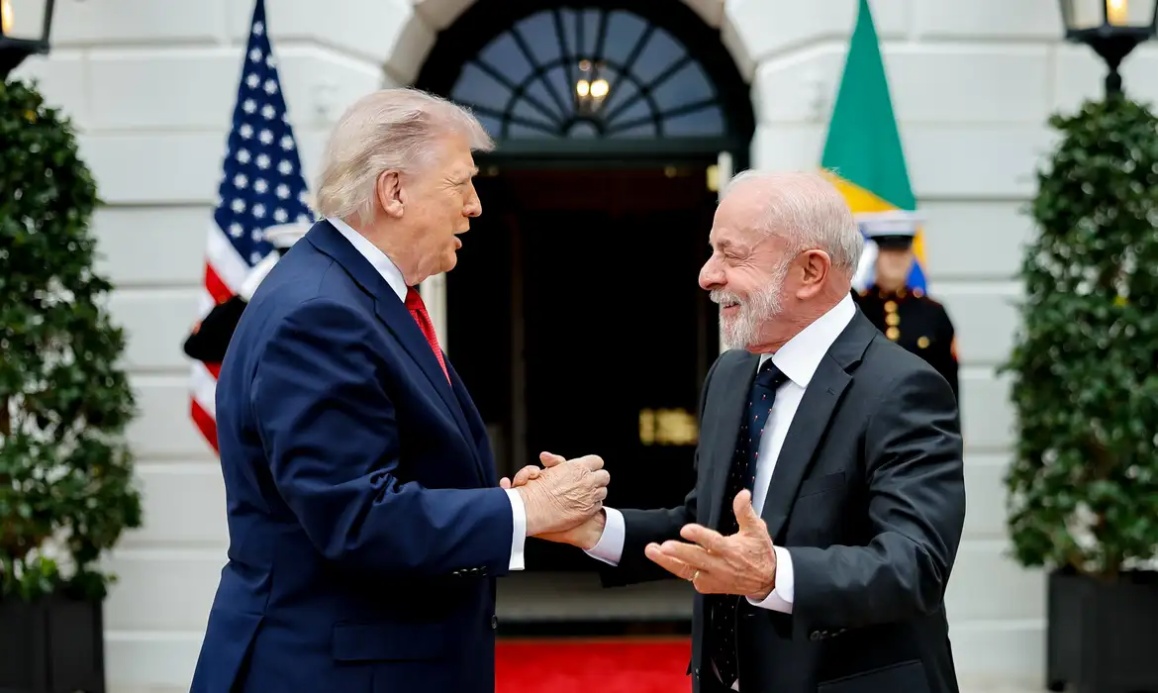
Brazilian President Luiz Inácio Lula da Silva stated this Thursday (7), after a meeting with US President Donald Trump at the White House in Washington, that teams from both governments should finalize a proposal to resolve the impasse over export tariffs and a trade investigation opened by the Americans against Brazil since last year, according to a note from "Agência Brasil". The goal is for a proposal to be presented to both leaders in about 30 days. Brazil reiterated its support for closing the investigation opened under Section 301 of the US Trade Act. "I said: 'Let's put together a working group and let's allow this young man [from the Ministry] of Industry and Commerce of Brazil, along with your Minister of Commerce, to sit down in 30 days and present us with a proposal so we can finalize it.' Whoever is wrong will give in. If we have to give in, we will give in," Lula told journalists at the Brazilian Embassy in Washington. In the proceedings, the US accuses Brazil of unfair competition, mentioning Pix (Brazil's instant payment system), tariffs on ethanol, illegal deforestation, and intellectual property protection. In April of this year, Brazilian technicians met in the US for clarifications, defending the country against the allegation of unfair practices. The Brazilian government does not recognize the legitimacy of unilateral instruments such as Section 301, arguing inconsistency with the rules of the World Trade Organization (WTO). According to Lula, the Pix issue was not mentioned during the meeting between the presidents.
Extended meeting
Lula and Trump met for more than three hours at the White House in Washington, including a lunch hosted by the American president. It was expected that both would address the press in the Oval Office before the meeting, but the Brazilian president requested that the press conference take place after the meeting. In a social media post, Trump reported that he discussed "many topics" with Lula, including trade and tariff issues, and called Lula "a very dynamic president." "The meeting was very productive. Our representatives have meetings scheduled to discuss some key points. Other meetings will be scheduled in the coming months as needed," wrote the American president. Lula arrived at the White House shortly after noon (Brasilia time). The meeting was previously negotiated by the teams of both countries, with the expectation of addressing various topics such as trade, combating organized crime, as well as geopolitical issues and critical minerals. To journalists, Lula said he left the bilateral meeting very optimistic. "I believe Brazil is prepared to discuss any subject with any country in the world. There are no forbidden topics. The only thing we will not give up is our democracy and our sovereignty. Everything else is open to discussion," the president stated.
Organized crime
During the press conference, Lula announced that the Brazilian government will launch a plan to combat organized crime "next week" and that, in the conversation with Trump, it was agreed that one of the areas of work between the two governments will be cooperation to financially suffocate transnational criminal organizations operating in Brazil and the US. "We need to destroy the financial potential of organized crime and factions," he argued. According to the Minister of Finance, Dario Durigan, teams from the Brazilian Federal Revenue Service and their US counterparts will conduct joint operations to block the smuggling of weapons and other products, including the illegal trafficking of synthetic drugs from the US. Lula also stated that they did not specifically discuss criminal factions operating in Brazil, such as Comando Vermelho and Primeiro Comando da Capital. The US government is considering changing the designation of Brazilian factions as terrorist groups, which, according to Brazil and experts, is a risk to sovereignty and does not help in the fight against crime. In April, Brazil and the United States had already announced a mutual cooperation agreement aimed at combating international arms and drug trafficking. The partnership provides for the sharing of information on seizures made at the customs offices of both countries, in order to enable a swift investigation of patterns, routes and links between senders and recipients of illicit products.
Rare earths
Another point addressed in the meeting between Lula and Trump was investments in the exploration of critical minerals and rare earths, which are fundamental in the manufacture of electronic components for high-tech equipment. In the press conference, Lula said he had informed Trump of the approval, this Wednesday (6), of the law that establishes the National Policy for Critical and Strategic Minerals (PNMCE). The project foresees, among other points, the creation of a committee or council responsible for defining which minerals are critical and strategic for the country. With approximately 21 million tons, the Brazilian reserve of rare earths is the second largest ever mapped in the world, second only to China, which holds approximately 44 million tons. However, only about 25% of the national territory has been mapped, which indicates a huge potential that is still unknown. "Anyone who wants to, Brazil will be open to building partnerships. What we don't want is to be mere exporters of these things. We don't want to repeat what happened with silver in Latin America, with gold in Brazil, with iron ore, which we send a lot of abroad, and we could have carried out an internal transformation process that we didn't. So, with rare earths, we are going to change our behavior," the president assured.
Visas revoked
Lula said he gave Trump a list of Brazilian officials and their families who are still suffering from US visa restrictions as retaliation for the trial regarding the attempted coup in Brazil. Part of the visa suspension has reportedly been lifted, but some people remain sanctioned, including, according to Lula, the 10-year-old daughter of the Minister of Health, Alexandre Padilha, and some ministers of the Supreme Federal Court (STF). The presidential delegation includes the Ministers of Foreign Affairs, Mauro Vieira; Justice and Public Security, Wellington César; Finance, Dario Durigan; Development, Industry, Trade and Services, Márcio Elias Rosa; Mines and Energy, Alexandre Silveira; and the Director-General of the Federal Police, Andrei Rodrigues.
History
Since 2025, trade relations between Brazil and the United States have been experiencing a period of tension stemming from the tariff policies adopted by President Donald Trump, who reinstated protectionist measures already observed during his first term. The cycle of disputes began with the imposition of 25% tariffs on steel and aluminum imports, directly affecting Brazil, one of the main suppliers of these products to the US market. The justifications presented by the US for these measures combined economic and political arguments. There was also criticism of the Brazilian Supreme Court, in the context of the Brazilian judiciary's decisions related to the case against former President Jair Bolsonaro, involved in the coup attempts that culminated on January 8, 2023. In April, the United States adopted additional tariffs on several Brazilian products, arguing a lack of trade reciprocity. The Brazilian government intensified diplomatic efforts and later took the issue to the World Trade Organization (WTO). Furthermore, Brazil has strengthened some of its legal instruments, such as reciprocity and retaliation measures, in an attempt to avoid further escalation by the US government. At the end of 2025 and the beginning of this year, there was a partial retreat by the United States, with exclusions of products and replacement of the tariff increase with a temporary global tariff of around 10%. Sectors such as steel and aluminum, however, continue with high rates. The Brazilian delegation returns to Brasília tonight with an expected arrival on Friday (8).
This text was translated by machine from Brazilian Portuguese.