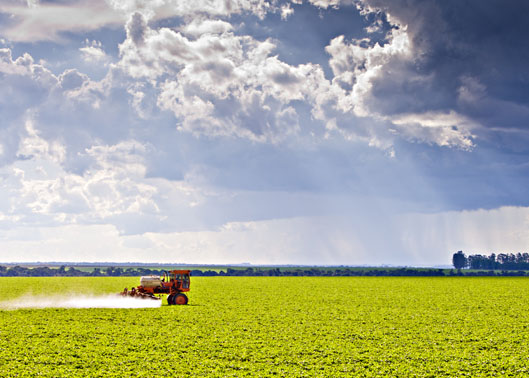
Brazilian imports of chemical pesticides reached US$4.28 billion between January and May 2026. This value is 6.8% lower compared to the same period in 2025 (US$4.59 billion). Of this amount, the entry of formulated products stands out, reaching US$1.4 billion, just over a third. The same occurred in volume: imports decreased by 6.5% in the same period, going from 537,300 tons to 502,600 tons. The detailed analysis of external purchases shows a pesticide market in adjustment, with a reduction in average prices and a greater share of generic products in imports. The analysis is from CropData, by CropLife Brazil. “The decline doesn't mean less protection in the field. The data reveals a change in the composition of Brazilian purchases, with a growing share of generic products, post-patent products, widely available on the global market. With tight margins, indebtedness, and credit compromised by judicial reorganizations, producers are diversifying their portfolios. The country faces bottlenecks in the approval of new technologies, with one of the longest registration times among the world's major agricultural economies. When innovation arrives late, the market orients itself towards what is already available. The advance of generics also has a regulatory aspect, which needs greater predictability,” analyzes Renato Gomides, executive manager of CropLife Brazil.
Imported Formulated Product
In this feature, the user can identify the commercial performance (value, volume, and average price) of formulated products, by segment classification (acaricides, household cleaning products, fungicides, herbicides, insecticides, nematicides, and growth regulators), active ingredient, and the five main countries of origin of the imports. In the case of formulated products, herbicides stood out the most in Brazilian imports, with US$ 471 million and 112,000 tons; however, both value, volume, and average price are marked by a decline between 2025 and 2026. Following herbicides are those with US$ 295 million, and fungicides with US$ 249 million, also showing a decrease. “Herbicides represent 34% of the value and almost 45% of the volume of imported formulated products in the first five months of 2026. Their importance is primarily agronomic. Weeds compete with crops for water, light, and nutrients. And in Brazil, with the widespread adoption of no-till farming, chemical control is irreplaceable. It eliminates mechanical soil disturbance, preventing erosion and compaction. Producers have expanded applications and the use of pre-emergent herbicides to ensure efficient management, especially in soybean, corn, and cotton systems, where protection in the early stages is crucial for productivity,” highlighted Gomides, regarding the herbicide class. When considering the origin of purchases, China is the main country for Brazilian imports of formulated herbicides, accounting for 72% of the value (US$ 338 million) and 90% of the total volume (100,000 tons). From a value perspective, the United States and Germany follow with 10% (US$47 million) and 5% (US$26 million), respectively. In terms of volume, the Asian country is followed by the US and India.
Importation by Active Ingredient
The platform's second new feature allows for the analysis of chemical pesticide imports by up to 19 active ingredients, comparing formulated and technical products. The information enables analysis by value, volume, and average price, as well as the five main countries of origin for the imports.
Marketing
The third unprecedented feature in the chemicals segment displays the commercialization of formulated products in the Brazilian domestic market, based on statistical data from the Brazilian Institute of Environment and Renewable Natural Resources (IBAMA). The available data (2024) indicates that Brazil sold 826,000 tons of formulated products. Considering the production of up to three harvests and the country's agricultural extension with grains, coffee, sugarcane, fruits and vegetables, and areas with eucalyptus and pine, sales of chemical pesticides totaled 7.73 kg/ha in 2024. This volume and metric indicator per hectare is used by the Food and Agriculture Organization of the United Nations (FAO) to estimate product consumption in the country.
This text was translated by machine from Brazilian Portuguese.