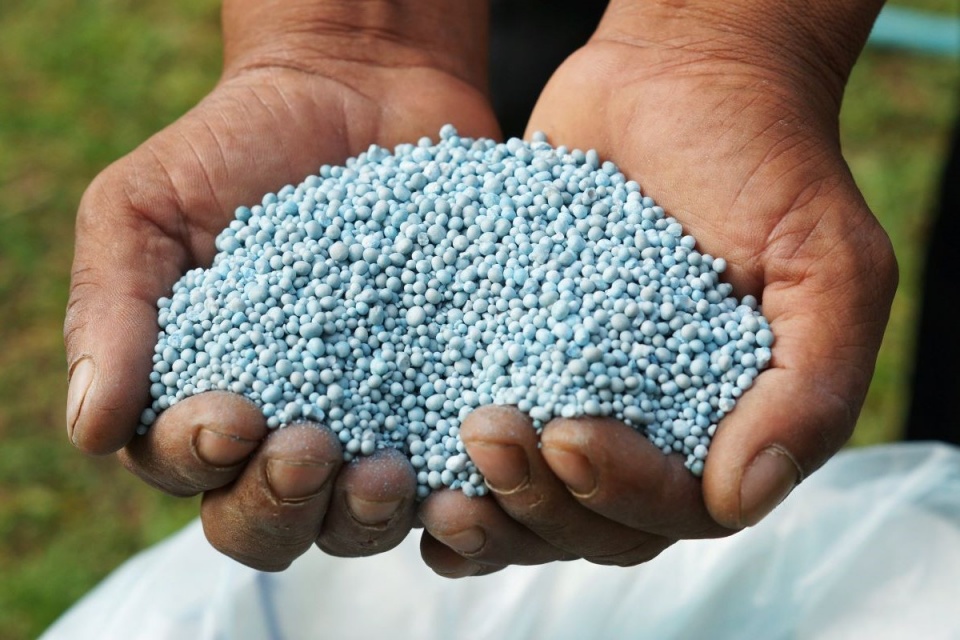
THE Brazilian agribusinessA global leader in the production of agricultural commodities, it depends on an essential input to sustain its productivity: fertilizersResponsible for providing nutrients such as nitrogen, match and potassium (NPK)These inputs are the basis of the country’s agricultural competitiveness — and, at the same time, one of its main points of… vulnerability.
The most recent figures highlight this structural dependence. According to data from National Association for the Dissemination of Fertilizers (ANDA), analyzed by the consulting firm DATAGROIn 2025, Brazil imported 45.6 million tons of fertilizers, with a highlight of 13.6 million tons of potassium chloride, 7.7 million tons of ammonium sulfate, and 7.8 million tons of urea.
In turn, total consumption during the same period reached 49 million tons, reflecting the continued expansion of national agricultural production.
This growth trajectory is consistent: 44.2 million tons were imported in 2024, 40.9 million in 2023, and 38.1 million in 2022. In other words, the advance of record harvests has been accompanied by a growing demand for fertilizers—without the country being able to expand its domestic production in the same proportion.
The result is a situation of external dependence that reaches about 90% of the fertilizers consumed in the country, according to the executive director of… Sinprifert, Bernardo SilvaIn some nutrients, the situation is even more critical: “We import 97% of the nitrogen, 100% of the urea, 97% of the potassium, 92% of the sulfur, and 74% of the phosphate,” he explains.
This dependence makes Brazil a country highly exposed to the fluctuations of the international market — especially during times of geopolitical instability.
Wars in the Middle East expose an old challenge.
Brazil’s vulnerability had already been evident in 2022, with the start of the war between Russia and Ukraine. At the time, Russia was responsible for about 25% of the fertilizers imported by Brazil, and the conflict caused a historic surge in prices, raising the cost. average per hectare over R$ 3,300, according to data from National Supply Company (Conab).
Now, a new global shock emerges with the advance of the war in Middle East, involving the United States, Israel, and Iran. The conflict, which began in February 2026, has brought one of the main bottlenecks in the global market back to the center of the debate: energy.
The Middle East plays a strategic role in the production of Fertilizers, especially nitrogen-based fertilizers, whose production depends directly on natural gas.
According to Bernardo Silva: “Nitrogen fertilizers are made using, for the most part, natural gas. Any disruption in production impacts the flow of LNG and affects the availability and cost of this raw material.”
Furthermore, The region accounts for approximately 40% of global urea exports, with Iran being one of the main producers.The threat of closure of the Strait of Hormuz — through which about 20% of the world’s oil passes — adds a critical logistical component, raising transportation, maritime insurance, and energy costs.
The effects are already visible in prices. Data analyzed by DATAGRO Data shows that urea in the Middle East reached US$665 per ton on March 23, 2026, an increase of more than 37% in 30 days. In Brazil, the impact was immediate, with prices reaching R$4,450 per ton CIF São Paulo — the highest level since 2022.
Another relevant point is the production chain. Not only natural gas, but also inputs such as sulfur — essential for phosphate fertilizers — are derived from oil and gas refining.
“The price of sulfur went from US$95 per ton in December 2024 to US$730 per ton today,” highlights Bernardo Silva.
Effects in the field
The surge in fertilizer prices has a direct impact on… profitability of the Brazilian producer, especially in regions that are more intensive in the use of inputs, such as the Midwest.
States such as Mato Grosso (MT), Paraná (PA) and São Paulo (SP) They account for more than a third of the national fertilizer consumption. In the case of Mato Grosso, the country’s largest soybean producer, the weight of fertilizers in operating costs has increased significantly over the last decade.
According to a survey by DATAGRO Grains, based on the data from Mato Grosso Institute of Agricultural Economics (Imea), between harvests 2014/15 and 2020/21, Fertilizers accounted for between 21% and 26% of the total cost.. From In 2021, this percentage exceeded 30%, reaching a peak of 43% in the 2022/23 harvest.at the height of the Ukraine crisis. Even after partial normalization, costs remain high, in the range of 31% to 32%.
This increase compromises the producer’s terms of trade — especially when commodity prices do not follow the same upward trend.
Bernardo Silva warns of this imbalance, “if we add to that the fact that agricultural commodities are not rising at the same rate, we have a problem with the terms of trade.”
In addition to the direct cost, there are significant indirect impacts, such as increased freight costs due to higher diesel prices; higher marine insurance costs; uncertainty about product availability; and difficulties in crop planning.
Domestic production is still limited.
Given this scenario, the discussion about national production gains momentum. Despite possessing abundant natural resources, Brazil still has a low domestic capacity for fertilizer production.The average production over the last five years has been around 7.2 million tons — well below national demand, according to the ANDA.
Currently, Brazilian production is mainly concentrated in nitrogen fertilizers, with particular emphasis on units linked to… Petrobras, like the FAFEN-BA (Bahia), FAFEN-SE (Sergipe), ANSA (Araucária – PR) and UFN-III (under construction).
Furthermore, private projects seek to expand national production, especially in the potassium segment. One of the main examples is… Autazes Project, from the Brazil Potash, which aims to produce up to 2.4 million tons of potassium chloride per year starting in 2029, potentially supplying about 20% of Brazilian demand.
In the institutional field, the National Fertilizer Plan (PNF)The plan, launched in 2022, sets goals to reduce external dependence and achieve up to 50% self-sufficiency by 2050.
According to Bernardo Silva, there have been important advances, such as tax adjustments and the creation of centers of excellence, but the pace is still insufficient. “The plan is moving forward, but we would like it to be faster,” says the director of Sinprifert.
The central role of natural gas: the real tipping point.
If there’s one thing the industry agrees on, it’s that… The main bottleneck for the development of the national fertilizer industry is the cost of natural gas..
As an essential raw material for the production of ammonia and urea, gas represents a significant portion of the total cost of nitrogen fertilizers. In Brazil, prices are still high compared to other producing countries.
“If gas prices fall to US$4 to US$7 per million BTU, it makes domestic production viable. The problem isn’t a lack of natural resources, it’s the regulatory environment,” assesses Bernardo.
In this context, initiatives such as Fertilizer Industry Development Program (Profert) They are gaining relevance. The project aims precisely to reduce the cost of natural gas to stimulate domestic production.
The logic is clear: without competitiveness in the gas sector, Brazil will remain dependent on imports — and, consequently, vulnerable to external shocks.
A structural crisis, not a cyclical one.
The current price surge reinforces a recurring diagnosis in the sector: the The fertilizer problem in Brazil is not an isolated incident, but a structural one.“This is the third crisis in a row: there was COVID, then Russia, now the Middle East. The problem is not cyclical, it’s structural,” the executive emphasizes.
Even in a hypothetical scenario of an end to the conflict in the Middle East, the trend is that prices will not return to historical levels.
Opening the strait may ease prices, but it won’t bring fertilizer prices back to previous levels, since there’s a whole logistical process involved in making the passage navigable again.
This text was translated by machine from Brazilian Portuguese.