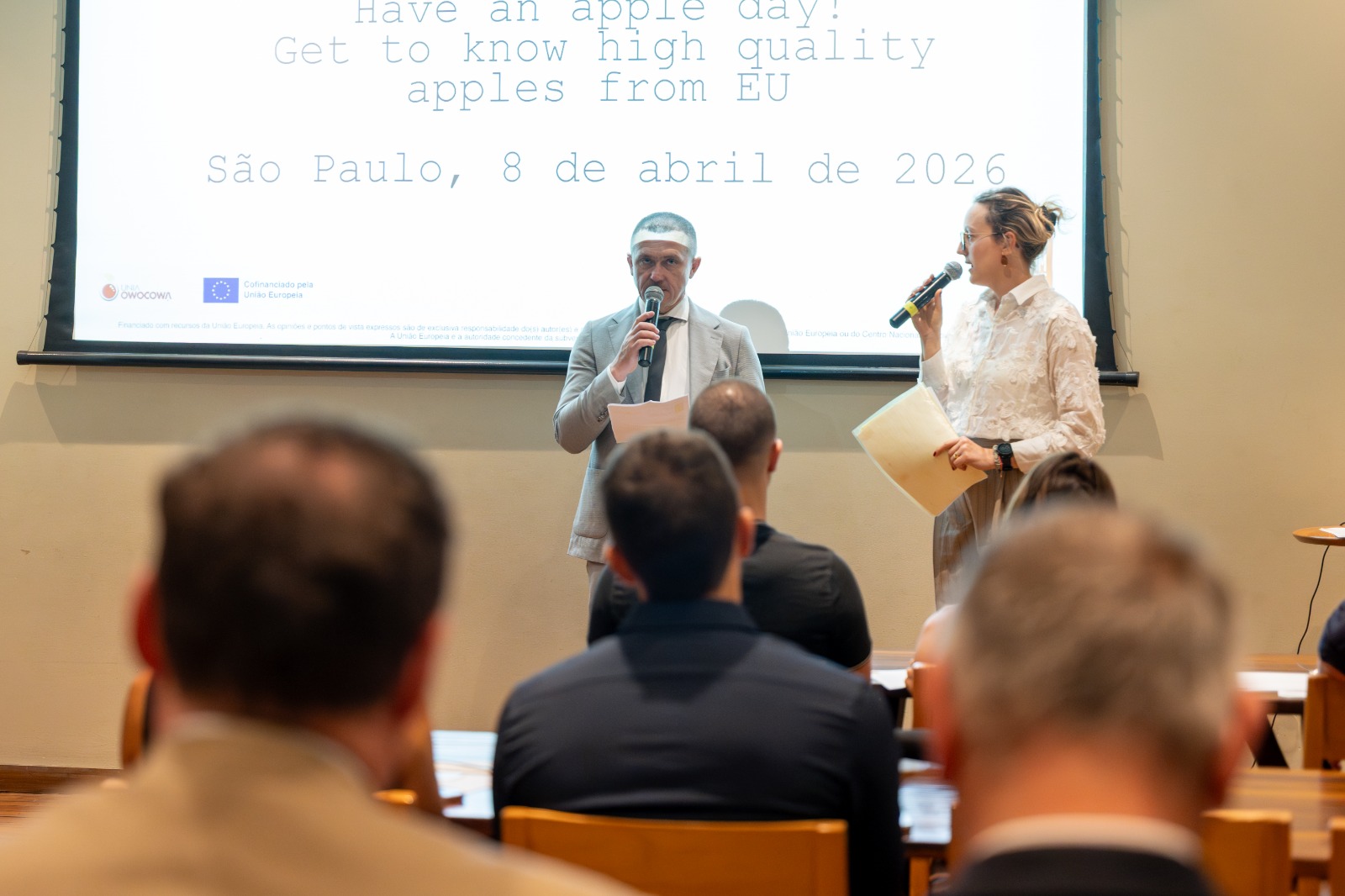
Coincidence or not – since the Mercosur-European Union agreement comes into effect, albeit provisionally, on May 1st – European fruit growers, particularly Polish apple producers, are preparing a kind of counter-attack against the anticipated expansion of Brazilian fruit in the old continent once the treaty comes into force. This week, participating in the Brazilian edition of the Anuga fair – the parent event for food and beverages originating in Germany – in São Paulo, the Polish Fruit and Vegetable Distributors Association (Fruit Union) announced the start of a commercial promotion campaign for European apples in the Brazilian and Colombian markets for the next three years. Called "Today is Apple Day! Discover the high-quality apples of the EU," the initiative is led by Fruit Union, bringing together not only producers from Poland – the largest European producer – but also from all over Europe, and aims to highlight the sanitary safety, quality, and sustainability attributes of European fruit. This significant initiative has the financial support of the European Union. Recent data from Fruit Union indicates that apple production in the European Union, particularly the Gala, Golden Delicious, and Red Delicious varieties, reached 11.6 million tons in 2024. The largest producer is Poland, with a harvest of 3.19 million tons and an average annual export of 784,000 tons. Demonstrating their commitment and proven they have done their homework, European producers reported that the latest figures indicate Brazilian apple imports jumped from 153,000 tons in the 2022/23 cycle to 235,000 tons in the 2023/24 season. EU apple exports to Brazil reached 81,000 tons in the 2024/25 season. "Domestic production represents about 75 to 78% of Brazil's domestic supply, so there is demand and we want to take advantage of it," says Piotr Janota, president of Fruit Union, adding that talks are underway with the Ministry of Agriculture and Livestock regarding a sanitary agreement between Brazil and Poland, which would enable the entry of the European product represented by Fruit Union. At Fruit Attraction São Paulo 2026, held at the end of March, the president of the Brazilian Association of Fruit and Derivative Producers and Exporters (Abrafrutas), Guilherme Coelho, pointed out that the gradual reduction of tariffs under the Mercosur-EU agreement will expand the presence of Brazilian fruits in the European market, "which already absorbs about 70% of our sector's foreign sales." According to the leader, the tariff reduction will begin with grapes, which will have their tax reduced to zero as soon as the agreement comes into effect. Other fruits will have different "grace" periods, according to the following schedule: avocados will have their 4% tariff reduced to zero in four years; Lemons and limes (14%) in seven years; melons and watermelons (9%) also in seven years. Apples, however, will only have their taxes reduced to zero starting in the tenth year of the treaty's implementation.
This text was translated by machine from Brazilian Portuguese.