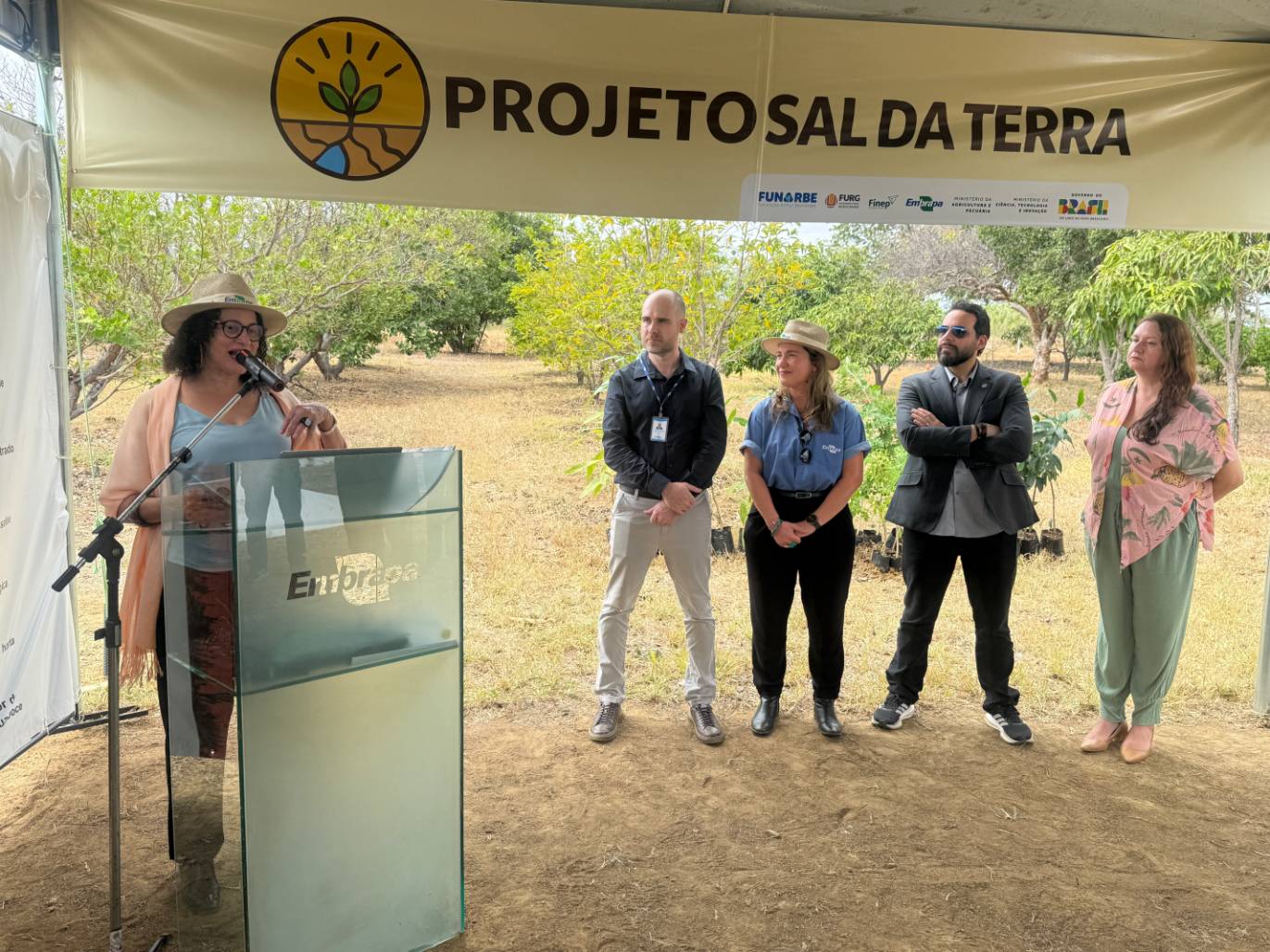
With an investment of approximately R$ 21 million, Embrapa and the Ministry of Science, Technology and Innovation (MCTI) launched the Sal da Terra Project in Pernambuco. The initiative will promote research and technology transfer for the productive use of brackish water in rural communities of the Brazilian Semi-Arid region served by the Água Doce Program. The project foresees the implementation of 50 productive units in biosaline agriculture, the training of approximately 700 family farmers, and the strengthening of production systems adapted to the environmental conditions of the region. The launch took place on June 26th at the Embrapa Semi-Arid Caatinga Experimental Field in Petrolina (PE), and was attended by the Minister of Science, Technology and Innovation, Luciana Santos, and the Director of Innovation, Business and Technology Transfer of Embrapa, Ana Euler. During the event, Minister Luciana Santos highlighted Embrapa's historical contribution to the development of Brazil and to the consolidation of the country as a world power in food production. "Embrapa has an extraordinary trajectory. It would not be possible to achieve the prominent position we occupy today without the science and technology developed by this institution. Brazil possesses enormous natural wealth, but it is through research and innovation that we are able to transform it into development and quality of life for the population," she stated. According to the minister, the Sal da Terra project represents the application of this science in solving complex challenges in the Brazilian Semi-Arid region. "The project, carried out in partnership with the MCTI (Ministry of Science, Technology and Innovation), will bring technological solutions to expand the productive use of brackish waters and strengthen family farming. It is science placed at the service of the population, social inclusion and sustainable development," she emphasized. In her speech, the director of Embrapa, Ana Euler, highlighted the alignment of the Sal da Terra Project with Embrapa's strategic guidelines, especially in the areas related to the management of natural resources, socio-productive inclusion, bioeconomy and integrated production systems, considered fundamental to facing the challenges posed by climate change. "Embrapa Semiárido is an institutional benchmark in adapting to climate change and has demonstrated, throughout its history, the ability to transform scenarios of restriction and scarcity into opportunities for development. The Sal da Terra Project represents exactly this vision, by expanding the possibilities for the productive use of brackish and saline waters available in the Semi-Arid region, contributing to income generation, food security, and the sustainability of regional production systems," he stated.
Learn about the Salt of the Earth Project
The "Salt of the Earth" Project, a result of the partnership between Embrapa and MCTI through the "Water for the Semi-Arid Region" Program, will be implemented in Alagoas, Bahia, Ceará, Paraíba, Pernambuco, Piauí, and Rio Grande do Norte, in communities served by the "Freshwater" Program. The project also has the partnership of the Federal University of Rio Grande (FURG) and funding from Finep. In Pernambuco, Embrapa Semi-Arid will play a strategic role in the execution of the initiative. The experimental area dedicated to biosaline agriculture will be revitalized to expand research on the productive use of brackish water and will house a permanent technological showcase at the Semi-Arid Show, allowing the demonstration of solutions developed by the company to producers, technicians, and partners.
Research and technology transfer
According to the project coordinator, the deputy head of Research and Development at Embrapa Semiárido, Diogo Porto, the actions are structured on two fronts: research and technology transfer. In the research area, studies will be conducted focusing on the generation and validation of technologies for the productive use of brackish water, including the evaluation of salinity-tolerant food and forage plants, microalgae production, the use of saline concentrate in animal nutrition, monitoring of water and soil quality, and research on the sustainability of biosaline production systems. The technology transfer actions include participatory diagnoses in rural communities, training of farmers, technicians and extension agents, implementation of production units and demonstration areas, as well as the dissemination of technologies already developed by Embrapa. Among these, the following stand out: tilapia farming using brackish water, the cultivation of saltbush (Atriplex spp.), and integrated production systems adapted to the conditions of the Semi-Arid region.
Articulation
The Salt of the Earth Project began to be developed in 2023, during the 10th edition of the Semiárido Show, when opportunities for integration between biosaline agriculture technologies developed by Embrapa and the infrastructure implemented by the Água Doce Program were discussed. The partnership was formalized in August 2025, during the 11th edition of the Semiárido Show, and in 2026, the project entered its execution phase. To date, launch events have already been held in Bahia, Ceará, Rio Grande do Norte, Paraíba, and Pernambuco.
This text was translated by machine from Brazilian Portuguese.