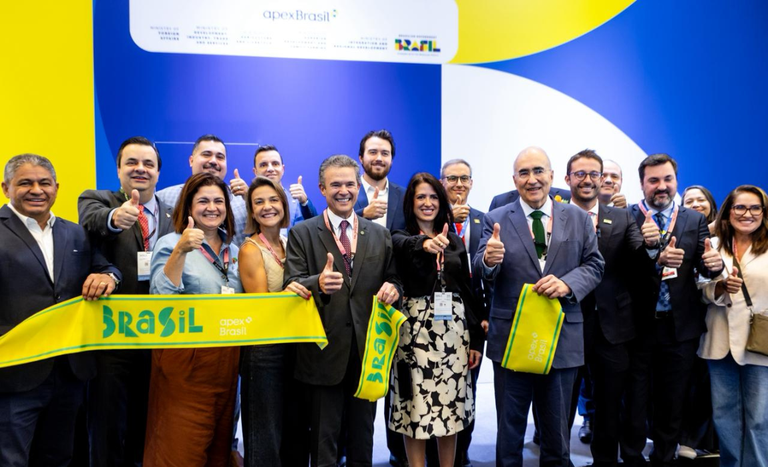
On an official mission to China, the Minister of Agriculture and Livestock, André de Paula, participated this Monday (18), in Shanghai, in SIAL 2026, considered the largest food and beverage fair in Asia. This year's edition marks a record participation by Brazil, with 82 exhibiting companies distributed in five pavilions organized by the Brazilian Trade and Investment Promotion Agency (ApexBrasil) and partner entities. The expectation is to generate around US$ 3.3 billion in immediate and prospective business. Brazilian participation in the fair reinforces the strategy of expanding agricultural exports, diversifying the export agenda and strengthening the presence of higher value-added Brazilian products in the Chinese market, the main destination for national agricultural exports. During the agenda, the minister visited the ApexBrasil pavilion and highlighted the joint effort between the government, the productive sector, cooperatives and entrepreneurs to expand the Brazilian presence in the international market. “This is a strategic space to expand trade relations, strengthen Brazil's image, and open new business opportunities. I have no doubt that it is this collective work, with everyone fulfilling their role competently, that allows the country to achieve increasingly relevant participation in the global market,” stated André de Paula. Visiting the Brazilian stands, the Brazilian ambassador to China, Marcos Galvão, highlighted the growth and diversification of the Brazilian business presence at the fair. “I am pleased to see a larger and more diverse Brazilian business representation than in previous editions. It is fundamental that we advance in the diversification of products and in positioning Brazil in the Chinese market with an increasingly consolidated brand,” he emphasized. The ambassador also emphasized the deepening of the bilateral economic relationship. According to him, in 2025 Brazil was the main destination for Chinese direct investment in the world, and China will remain the largest market for Brazilian exports. For Galvão, this scenario reflects Chinese confidence in Brazil as a strategic food supplier.
Brazilian pavilion
The Brazilian delegation brings together companies from the processed food, specialty coffee, Amazonian fruit, beverage, animal and vegetable protein, honey, nuts, and socio-biodiversity product sectors, highlighting the growing diversification of Brazil's export portfolio and the potential for adding value to national agriculture. The pavilions host tastings, business roundtables, meetings with international buyers, and business forums throughout the program. ApexBrasil directly coordinates the World Food and Protein pavilions, in addition to actions carried out in partnership with sectoral entities such as the Brazilian Association of Meat Exporting Industries (ABIEC), the Brazilian Association of Animal Protein (ABPA), and the Confederation of Agriculture and Livestock of Brazil (CNA), through the AgroBR project. During a visit to the ABIEC stand, Minister André de Paula emphasized the strategic importance of the animal protein chain for Brazilian agribusiness. “It’s impossible to visit this pavilion and not feel proud of what Brazil presents. This reflects the importance of the animal protein chain for Brazilian agribusiness and the leading role the sector plays on the international stage,” he stated. Another highlight of the mission is the internationalization of the Cooperate to Export program. After its international debut during Gulfood 2026 in Dubai, the initiative is participating for the first time in an agenda in China, with a pavilion dedicated to Brazilian family farming. The space brings together 10 cooperatives from different regions of the country and presents products such as specialty coffees, açaí, nuts, honey, wines, fruit pulps, and items from Brazilian socio-biodiversity to the Chinese market. “We are expanding the presence of Brazilian companies in the Chinese market, strengthening traditional sectors and opening space for cooperatives, family farming, and higher value-added products. The record number of companies at SIAL demonstrates the confidence of the Brazilian productive sector in the potential of this market,” emphasized the president of ApexBrasil, Laudemir Muller.
SIAL Shanghai
SIAL 2026 will take place from May 18th to 20th in Shanghai, bringing together more than 5,000 exhibitors from over 75 countries and regions. It is expected to receive approximately 180,000 professional visitors from more than 110 countries, in an exhibition area of up to 200,000 square meters. Recognized as one of the leading global trade fairs in the food and beverage sector, SIAL Shanghai showcases trends, innovations, and business opportunities in segments such as meat, organic products, beverages, and snacks. Since 2000, the event has established itself as a strategic platform for accessing the Asian market and expanding Brazilian exports.
Brazil-China Agribusiness Seminar
On Sunday (17), the minister participated in the Brazil-China Agribusiness Seminar, which brought together businesspeople and representatives from the public and private sectors of both countries to discuss business opportunities, commercial cooperation and the expansion of agricultural exchange. During the meeting, the minister highlighted the strategic importance of the bilateral relationship between Brazil and China and the work carried out by Mapa to expand access for Brazilian products to the Chinese market. “The Ministry of Agriculture and Livestock has been working continuously to expand and diversify this partnership. In recent years, we have intensified dialogue with the General Administration of Customs of China, with the Ministry of Agriculture and Rural Affairs and with other Chinese authorities, enabling the opening of new markets and the improvement of sanitary and phytosanitary protocols governing bilateral trade,” said André de Paula. The minister also stressed the priority nature of the international mission. “This is the first stage of my first international trip as head of the Ministry, and the choice of China is no coincidence. It is Brazil's main trading partner. We had the opportunity to bring Chinese importers and Brazilian businesspeople closer together, strengthening dialogue and creating new business opportunities,” he said. The Secretary of Trade and International Relations of the Ministry of Agriculture, Luis Rua, emphasized the advantages of Brazilian agriculture in the international market. “Brazil has fundamental attributes to meet global demand: quality, quantity, health, sustainability, competitiveness, and stability of supply. In other words, it is a partnership that has everything to be a win-win situation for Brazil and China,” he stated. Also present at the seminar, the president of the Brazilian Trade and Investment Promotion Agency (ApexBrasil), Laudemir Muller, highlighted the progress of the trade relationship between Brazil and China in the last two decades. According to him, "the bilateral flow went from about US$ 8 billion in 2003 to approximately US$ 170 billion last year." The official also highlighted the growth of Brazilian exports of animal protein to the Chinese market, which increased from less than 100,000 tons to approximately 1.7 million tons during the period. The Brazilian ambassador to China, Mauro Galvão, emphasized the preparedness of the participating Brazilian companies and the importance of closer ties between the productive sectors of the two countries. “Companies selected by the Ministry of Agriculture and Livestock (MAPA) and the National Confederation of Agriculture (CNA) are here to engage with buyers who know the market, understand the consumer, and have the capacity to expand distribution channels and positioning of Brazilian products,” he stated. The diplomat also highlighted the context of the Brazil-China Cultural Year and advocated for strengthening long-term partnerships between Brazilian and Chinese companies, focusing on commercial stability, joint promotion, and expanding mutual understanding between the countries. The director of the Department of Agribusiness Promotion at MAPA, Ângela Perez, stated that strengthening the agri-food relationship between the two countries involves diversifying the export agenda and building long-term partnerships. “This event was designed to bring companies closer together, build trust, and open new opportunities. The Ministry of Agriculture and Livestock will continue working to strengthen this environment of cooperation, dialogue, and joint development,” he emphasized. Brazilian companies from the apicultural products, coconut water, coffee, açaí, nuts and chestnuts, chocolate, jams, and fruit pulp sectors participated in the seminar, highlighting the potential for adding value and diversifying the national export agenda. Between 2023 and 2026, 12 new markets were opened in China for Brazilian agricultural products, including poultry meat and derivatives, corn DDG (dry distillers grains), peanut meal, flours and oils of animal and fish origin, sesame, pecans, fish, sorghum, and grapes. This progress reflects the strengthening of sanitary and phytosanitary negotiations conducted between the two countries.
Brazil-China trade
In 2025, Brazilian agribusiness exports to China reached US$55.22 billion, maintaining the Asian country as the main destination for the sector's products. The soybean complex led the export agenda, with US$34.61 billion, equivalent to more than 62% of the total shipped. Meat (US$9.82 billion), forestry products (US$5.06 billion), the sugar and ethanol complex (US$1.90 billion), and fibers and textile products (US$872 million) also stood out. During the same period, Brazil imported US$1.59 billion in agricultural products from China, with emphasis on forestry products (US$501 million), fibers and textiles (US$285 million), horticultural products, legumes, roots and tubers (US$169 million), other products of plant origin (US$161 million), and animal feed (US$116 million). Considering all sectors of the economy, bilateral trade between Brazil and China reached US$170.9 billion in 2025. China accounted for 28.7% of Brazilian exports and 42.6% of the country's trade surplus. Brazilian exports to the Chinese market remain concentrated in commodities, particularly soybeans, crude oil, and iron ore.
Cooperatives
Also on Sunday, the minister participated in a meeting with representatives of Brazilian agricultural cooperatives. The agenda was promoted by Ourofino Agrociência and was part of the “Asia Expert” technical mission, which brings together leaders of Brazilian agricultural cooperatives in a program focused on strengthening relations with Asian markets, with visits to China, South Korea, and Japan. During the meeting, the minister highlighted the importance of continuing the strategic agendas of Brazilian agribusiness and reinforced China's role as Brazil's main trading partner. “I took over the Ministry of Agriculture and Livestock about 45 days ago with the commitment to continue a work built consistently over the last few years. And it is no coincidence that one of the first international agendas is in China, our largest trading partner. We need to continue strengthening this relationship, expanding opportunities and consolidating Brazilian agriculture as one of the pillars of global food security,” he said. The CEO of Ourofino Agrociência, Marcelo Abdo, presented the Asia Expert program to the participants, an initiative focused on the strategic preparation of the Brazilian agricultural sector for operations in the Asian market. “Asia has ceased to be a complementary agenda and has come to occupy a strategic position for Brazil's future. The Asia Expert program was developed precisely to bring Brazilian agricultural leaders closer to the transformations underway in the region and to contribute to building long-term relationships with Asian partners,” he emphasized. Representatives from cooperatives participating in the mission attended the meeting, including C.Vale, Lar Cooperativa Agroindustrial, Comigo, Copacol, Coopercitrus, Integrada Cooperativa Agroindustrial, Cotrijal, Copasul, and Coplacana.
This text was translated by machine from Brazilian Portuguese.