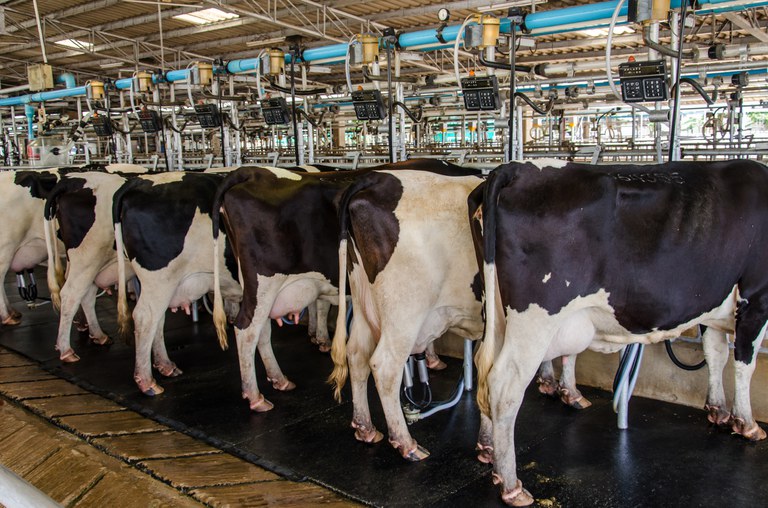
Raw milk acquisition in Brazil totaled 6.78 billion liters in the first quarter of this year, an amount 2.6% higher compared to the first three months of 2025 and a historical record for the period, according to data from the Brazilian Institute of Geography and Statistics (IBGE), released this Tuesday (16). Compared to the last three months of last year, however, acquisition fell by 8.0%. It is worth noting that IBGE data only considers operations carried out by establishments that operate under some type of sanitary inspection (Federal, State or Municipal). January was the month with the highest collection, with 2.4 billion liters, while February had 2.1 billion, and March 2.2 billion, positive variations of 3.9%, 2.2% and 1.6%, respectively, compared to the same months of the previous year. The Southern Region presented the highest proportion of raw milk collection, 41.2% of the total, followed by the Southeast (36.4%), Midwest (9.7%), Northeast (9.3%), and North (3.5%) regions. Comparing the first quarter of 2026 with the same period in 2025, 12 of the 26 Brazilian states showed an increase in raw milk acquisition. The most significant positive variations occurred in: Paraná (+88.74 million liters), Rio Grande do Sul (+60.24 million liters), Santa Catarina (+44.56 million liters), and Minas Gerais (+26.63 million liters), while the main decreases occurred in: Goiás (-36.25 million liters), Rondônia (-16.05 million liters), and Mato Grosso (-15.09 million liters).
Leather purchases remain stable year-on-year.
The tanneries investigated by the IBGE survey – those that tan at least 5,000 whole units of raw bovine leather per year – reported receiving 10.75 million pieces in the first quarter of 2026. This volume represents stability compared to the same quarter of the previous year, but a 3.3% decrease compared to the immediately preceding quarter. Regarding the origin of the leather, most came from slaughterhouses, followed by service providers, which together accounted for 90.7% of the total collected during the period. Comparing the first quarter of 2026 with the same period in 2025, leather acquisition increased in 9 of the 17 federative units investigated by the IBGE. The most significant positive variations occurred in Mato Grosso (+243,100 pieces), Mato Grosso do Sul (+43,370 pieces), and São Paulo (+19,180 pieces), while the main decreases occurred in Goiás (-429,100 pieces), Paraná (-46,950 pieces), and Rio Grande do Sul (-3,650 pieces). The Central-West region had the largest number of establishments (28.9%) and pieces received (47.8%) in the first quarter of 2026. The North, although with only 13.3% of the establishments, accounted for 21.2% of the pieces acquired in the quarter. Following are the South region, with 25.3% of the establishments and 14.7% of the pieces; and the Southeast region, with 24.1% of the establishments and 11.7% of the pieces. and the Northeast region with 8.4% of establishments and 4.5% of parts.
This text was translated by machine from Brazilian Portuguese.