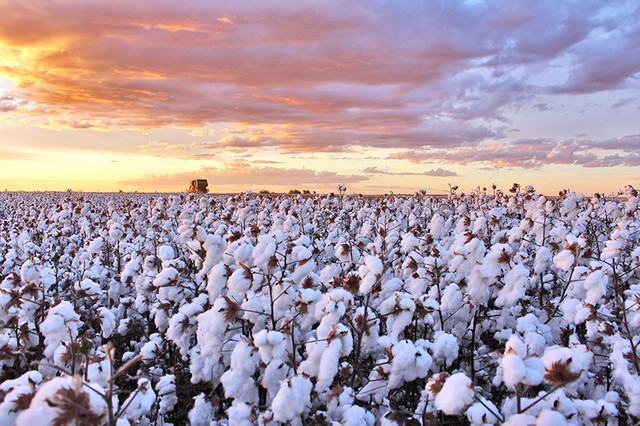
Brazilian cotton exports are expected to close the 2025/26 commercial cycle at a new historical level, with approximately 3.3 million tons shipped. The projection was presented this Thursday (25), in Angra dos Reis (RJ), during the 83rd Ordinary Meeting of the Sectoral Chamber of the Cotton and Derivatives Production Chain of the Ministry of Agriculture (Mapa), which opened the program of the XXIII Anea Cotton Dinner, promoted by the National Association of Cotton Exporters (Anea). According to the Brazilian Association of Cotton Producers (Abrapa), which chairs the Sectoral Chamber, in the current crop, 2025/26, Brazil should harvest around 3.9 million tons of lint (processed cotton), in an area of 1.9 million hectares, with projected productivity of approximately 1,954 kilos per hectare. For the next crop (2026/2027), preliminary figures indicate 3.96 million tons. According to the president of Anea, Dawid Wajs, the performance in exports and production confirms Brazil's strength in the international cotton trade. Anea reports that the country registered record exports for seven months of the cycle and is ending the season consolidated as the world's largest cotton exporter, ahead of the United States. External demand remains supported by markets such as China, Bangladesh, Vietnam, Pakistan, Turkey, India, Egypt, and other strategic destinations for the global textile industry. “Brazilian cotton has reached a new level in the international market. We had seven record export months, and June should follow the same pace. Today, the challenge is no longer just to produce more, but to guarantee infrastructure, competitiveness, and predictability to sustain this growth,” stated Wajs.
Global supply and demand
The international scenario was treated with caution, but also with opportunities for Brazilian cotton. According to Wajs, after years of pressure on prices, the market is once again operating in a more volatile environment, influenced by factors such as trade relations between the United States and China, geopolitical tensions, central bank decisions, climate, and the behavior of synthetic fibers. "For the first time in years, global projections indicate cotton consumption exceeding supply, respectively, by 26.510 million and 25.265 million tons, a movement that could contribute to a more favorable environment for prices," he said.
This text was translated by machine from Brazilian Portuguese.