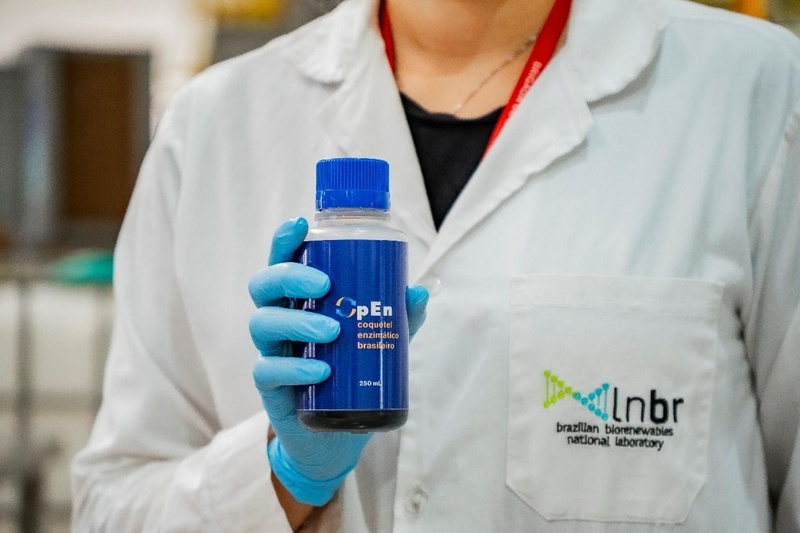
The Brazilian National Center for Research in Energy and Materials (CNPEM) has launched a public call for the distribution of samples of a vital biotechnological input for biorefineries. The enzymatic cocktail, called OpEn, developed entirely in Brazil, has the potential to reduce greenhouse gas emissions and revolutionize the production of biofuels and bioproducts in the country. The distribution of the OpEn cocktail is aimed at researchers from non-profit academic and scientific institutions interested in co-developing, customizing, and improving the technology for different production chains and types of plant biomass. The target audience includes academic researchers affiliated with public or private ICTs, universities, and research centers. Companies and startups can also request the technology, subject to direct evaluation by CNPEM. “The OpEn cocktail is an enabling technology for biorefineries, the result of 15 years of investment and research in advanced biotechnology, which motivated the creation of an area within CNPEM with the potential to generate end-to-end technological autonomy for the sustainable national production of energy and other bioproducts,” explains Mario Murakami, director of the National Laboratory of Biofuels at CNPEM. Currently, Brazil still depends on imported enzymes with no national equivalent available on a commercial scale. With proven performance and patented technology, OpEn now has more than eighty versions, adapted to various production chains and improved by biodiversity discoveries, achieving a reduction of up to 50% in greenhouse gas emissions. "OpEn technology is the result of integrating various infrastructures and expertise from CNPEM, demonstrating how our multidisciplinary capacity can transform Brazil from a commodity producer into a developer of advanced biotechnologies. By combining sustainability and innovation, this enzymatic cocktail is strategic for our bioeconomy and helps position the country at the forefront of biofuel and bioproduct production," highlights Antonio José Roque da Silva, Director-General of CNPEM. Produced from byproducts of the sugarcane industry, OpEn has a low cost, generates no waste, and allows the use of remaining biomass as animal feed. The technology was customized to meet the specific conditions of Brazilian biorefineries, with high flexibility for different raw materials, including sugarcane, corn, and forestry residues. The cocktail has already been validated in a pilot plant with 100% reproducibility, and more than five tons have been produced and validated to date. OpEn technology features adaptations that include genetic modifications to enzymes in the fungus *Trichoderma reesei*, aiming to increase the productivity and efficiency of converting agro-industrial waste into energy, food, and biochemicals. In addition to producing 2G and 1.5G ethanol, OpEn can be applied in integrated industrial processes, animal nutrition, and new biomass depolymerization routes. :: 2G and 1.5G Ethanol: What are they? Second-generation (2G) ethanol is produced from plant residues such as bagasse and sugarcane straw, which are not normally used in conventional (1G) production based on sugarcane juice. 1.5G ethanol maximizes the use of corn grains, including residual fractions from processing, allowing for greater utilization of biomass without requiring adaptation of industrial infrastructure. :: Distribution for basic and applied research purposes The public call allows Brazilian academic institutions to receive a free 250 ml sample of the cocktail for laboratory testing, subject to approval and signing of a Material Transfer Agreement (MTA). :: Advances inspired by biodiversity One version of the OpEn technology incorporates an important discovery from Brazilian biodiversity: the CelOCE enzyme. This is a new class of biocatalyst with a unique structure and mechanism of action, capable of accelerating cellulose transformation and increasing glucose release by up to 21% under industrial conditions. Due to its minimalist structure with only 115 amino acids, the substance opens up prospects for new future uses or even the development of synthetic enzymes, with applications including the reuse of plastic waste. The discovery, published in the journal Nature, expands the prospects for the development of even more efficient formulations of OpEn technology, strengthening the transition to a low-carbon bioeconomy and demonstrating the importance of preserving Brazilian biodiversity. For more information: coquetelenzimatico@cnpem.br.
This text was translated by machine from Brazilian Portuguese.