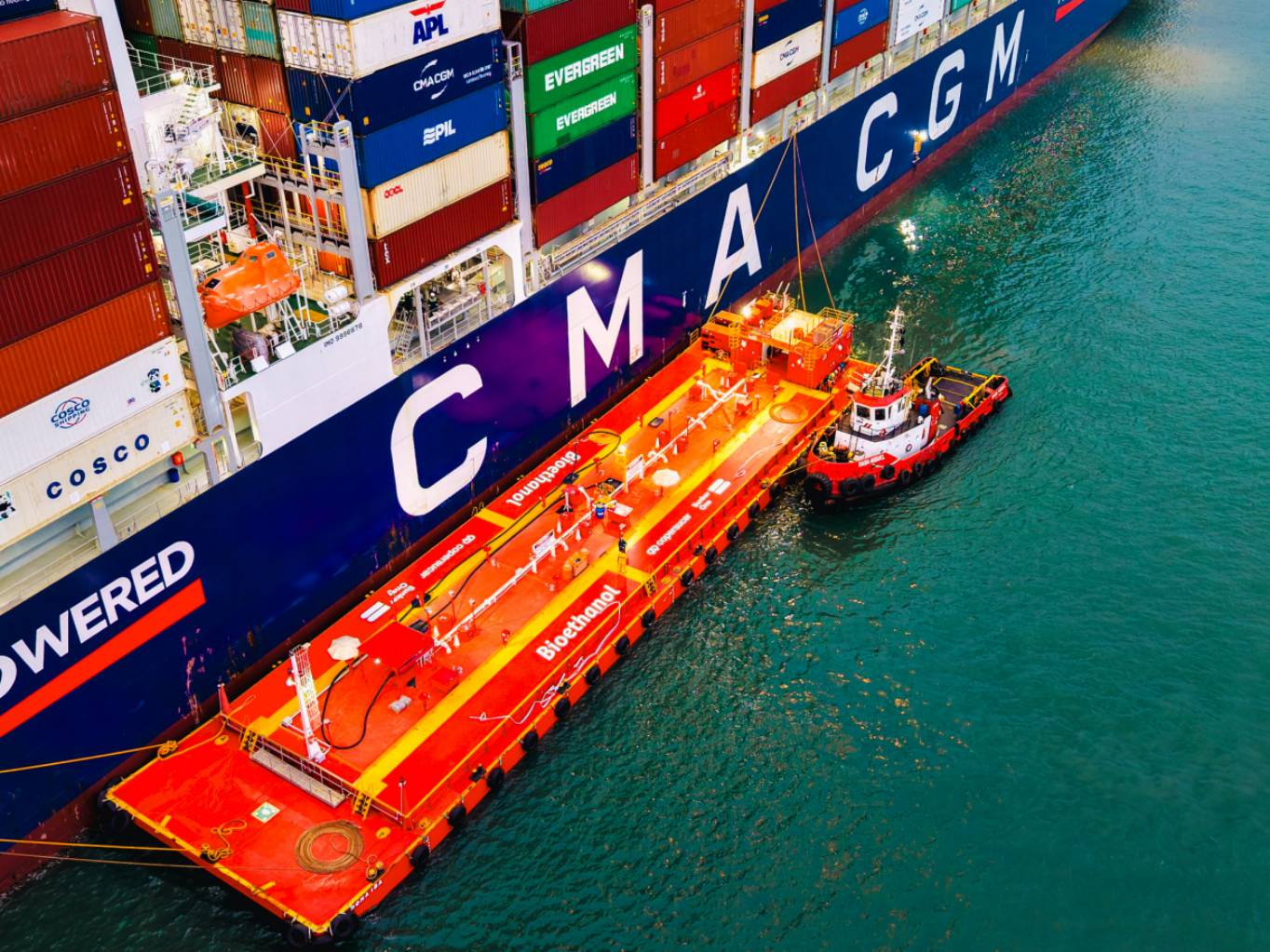
Copersucar, a Brazilian sugar and ethanol trading company; the French maritime transport and logistics company CMA CGM; AGEO Terminais, a liquid bulk storage facility; Santos Brasil, a container terminal; and Bunker One, a subsidiary of the Danish group Bunker Holding, specializing in bunker fuel – marine fuel; carried out this Sunday (12) the first refueling of a container ship with ethanol in Brazil. The operation refueled the CMA CGM IRON, the first 13,000 TEU container ship equipped with a certified tri-fuel engine. In a statement sent to the professional press, the partners highlight that the refueling demonstrates, in practice, that ethanol has attributes capable of accelerating the decarbonization of maritime transport. "In addition to providing a significant reduction in greenhouse gas emissions, it offers immediate availability on a commercial scale, production infrastructure already consolidated in Brazil and economic competitiveness, relevant characteristics in the face of the growing global demand for sustainable fuels," says the note. “Together with our partners, we have demonstrated that innovation can move from the laboratory to real maritime operations. The certification of our first vessel with a tri-fuel engine represents an important technological milestone for CMA CGM. It paves the way for the wider use of lower-carbon fuels and offers us new alternatives to accelerate the decarbonization of our maritime transport operations,” says Christine Cabau Woehrel, Executive Vice President of Assets and Operations at CMA CGM. “This operation demonstrates Copersucar's ability to connect production, logistics, and the market to enable bioenergy solutions at scale. More than a pioneering supply, we are building the conditions for ethanol to competitively integrate into the energy matrix of shipping, expanding Brazil's leading role in the transition to a low-carbon economy,” emphasizes Tomás Manzano, president of Copersucar. “This operation can be considered a milestone in the energy transition of the maritime industry worldwide, which is beginning to adapt to this model. Currently, approximately 70 ships in the global fleet can be fueled by methanol and, consequently, by ethanol. But the forecast is that, in the coming years, another 400 vessels will leave the shipyards capable of sailing on a non-fossil fuel,” adds Flavio Ribeiro, CEO of Bunker One.
This text was translated by machine from Brazilian Portuguese.