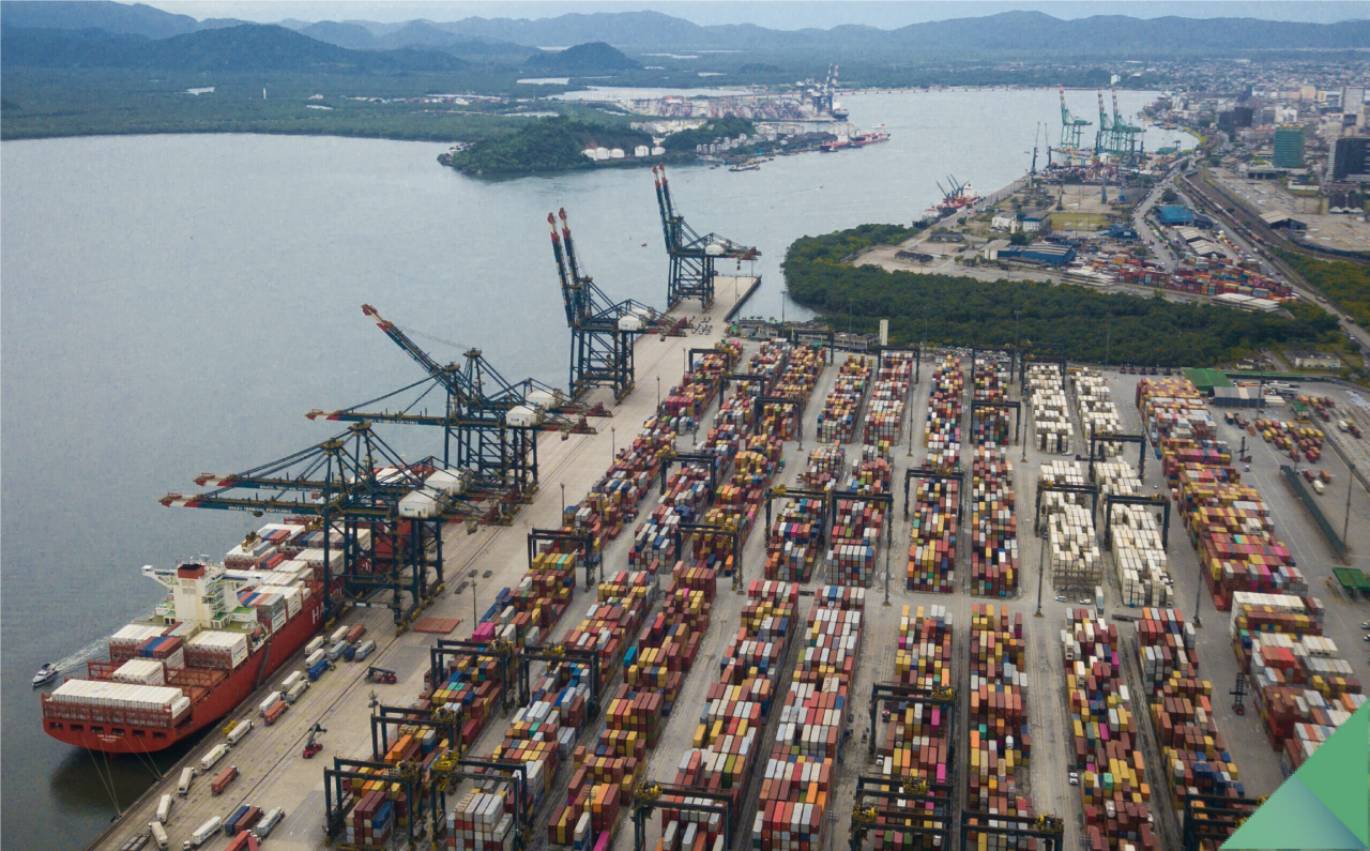
On July 2nd, the National Waterway Transportation Agency (Antaq) sent a statement to the Civil House contradicting the recommendation presented by the federal government for the auction of Tecon Santos 10, the new container terminal at the Port of Santos. The Civil House's recommendation called for broad participation in the bidding process, conditional on a commitment to divestment by any winner who already owns port assets in the region, in addition to raising the minimum concession fee to R$ 1.044 billion. The Brazilian Coffee Exporters Council (Cecafé) criticizes the fact that, even with the public policy direction given by the Presidency of the Republic, Antaq has chosen to maintain its proposal to hold the auction in two phases, restricting, in the first phase, the participation of shipowners who already own container terminals at the Port of Santos. The guidance was given in a dispatch signed by the Agency's Director-General, Frederico Carvalho Dias, based on technical note 17/2026, signed by João Paulo Undiciatti Barbieri, head of the Concessions Bidding Division, and on dispatch SEI 2945552, by Ygor Di Paula Julliano Silva da Costa, president of the Permanent Commission for Port Lease Bidding (CPLA). According to Cecafé, the Agency's position was maintained without the presentation of studies, indicators, technical evidence, or economic analyses that demonstrate the necessity or proportionality of the measure. “The decision does not present data, evidence, or technical studies that consistently support this restriction, especially in light of analyses produced by the Agency itself, such as Technical Note No. 51, and by AudPortoFerrovia, a technical unit of the Federal Court of Accounts (TCU), whose conclusions point in the opposite direction to the measure adopted,” reveals Eduardo Heron, the entity's technical director. As a representative of the coffee exporting sector, Cecafé expresses concern and dissatisfaction with Antaq's decision. According to the Council, maintaining restrictions on the bidding process disregards the critical situation faced by containerized cargo at the Port of Santos, which has been dealing with capacity limitations, operational congestion, and high logistics costs for years. Cecafé also warns that the model advocated by Antaq significantly increases the risk of litigation, potentially resulting in further delays for a project considered essential to the expansion of Brazilian port infrastructure. "Those who will continue to pay this price are the port users and the entire Brazilian society. The increase in logistics costs will inevitably continue to be reflected in the competitiveness of exports and the final prices of products consumed by the population," states Heron. Regarding Antaq's decision, he recalls that the Regulatory Agency must exercise its duties based on objective criteria, concrete evidence, and consistent technical analyses. “It is not up to Antaq to choose winners or restrict potential participants in advance without robust justifications. Its role is to guarantee regulatory security, efficiency, and predictability, in accordance with the public policies defined by the Granting Authority,” he points out. The director of Cecafé adds that, according to its own institutional mission, Antaq was created to regulate, supervise, and oversee the provision of services and the exploitation of waterway and port infrastructure. “Therefore, by defending restrictions whose technical basis has not been demonstrated transparently, the Agency ends up distancing itself from this regulatory function and entering into a competitive debate that already has specific instruments and bodies for analysis and eventual intervention,” he adds. The director of Cecafé emphasizes that the Civil House itself, through Technical Note No. 11/2026/SIEC/SEPPI/CC/PR, recommended the removal of restrictions on participation in the first phase of the auction, preserving divestment mechanisms to address any competitive concerns. Despite this, after months of analysis, Antaq opted to maintain its original understanding and the two-stage bidding model. Heron also points out inconsistencies in the Agency's regulatory actions when comparing the treatment given to Tecon Santos 10 with the model adopted for the definitive lease of the ITJ01 terminal in Itajaí (SC), which allowed broad participation in the bidding process, limiting only specific corporate compositions. “When we observe different decisions for comparable situations, without clear technical justifications for this differentiation, legal uncertainty increases and the perception of unequal treatment among economic agents grows,” he analyzes. He reinforces that the Port of Santos urgently needs to advance a structural agenda for expanding its logistical capacity, which includes Tecon Santos 10, deepening the navigation channel, new road access, and railway improvements. “Cargo users cannot continue to wait indefinitely. The risk of litigation arising from restrictions without clear technical justification generates delays, discourages investment, and postpones essential solutions for the competitiveness of Brazilian foreign trade,” he explains. The technical director of Cecafé also recalls that the auction of Tecon Santos 10 has been awaited for over 13 years, its publication has been postponed several times, and the insistence on a model that restricts participants without widely demonstrated technical evidence creates an environment conducive to legal disputes, further extending the time for the process to be completed. “We see a scenario that will certainly further prolong the time for investments that could mitigate the lack of capacity in the Port of Santos, which will keep users exposed to increasing losses resulting from the current deficiency in port infrastructure. The most affected will continue to be exporters, importers, and the entire national production chain,” concludes Heron.
This text was translated by machine from Brazilian Portuguese.