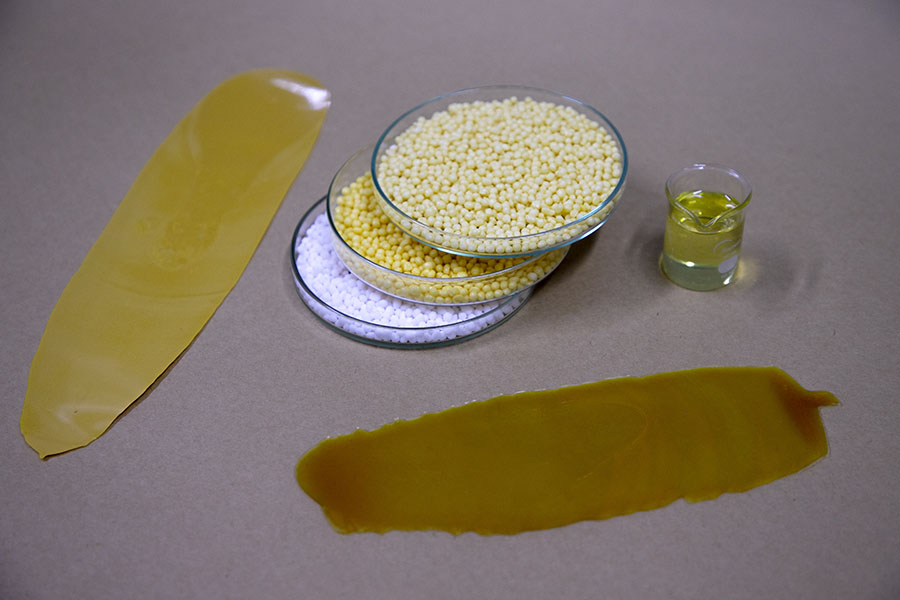
Researchers from Embrapa and the universities of Ribeirão Preto (Unaerp), São Paulo State (Unesp), and São Paulo (USP) have developed a coating based on a polymer derived from castor oil and mineral clay that is capable of releasing urea, a nitrogen fertilizer widely used in agriculture, in a controlled manner. Greenhouse tests with piatã grass demonstrated that the coated fertilizer promoted better nitrogen absorption by the plant and greater biomass production compared to uncoated urea. This is the first plant-based evaluation of this type of castor oil and nanoclay coating carried out in Brazil. The coating reduces costs and fertilizer waste in the soil. The experiments, conducted at the National Nanotechnology Laboratory for Agribusiness (LNNA), located at Embrapa Instrumentation (SP), and at the Processes and Materials Laboratory (ProMat) of the University of Ribeirão Preto, showed the immediate impact of the technology. Uncoated urea released more than 85% of its nitrogen in just four hours in water release tests, according to Unaerp professor Ricardo Bortoletto-Santos, supervised in his postdoctoral research by Embrapa researcher and LNNA coordinator Caue Ribeiro. “When the urea was coated only with polyurethane, a polymer derived from castor oil, this release was delayed, but reached about 70% in nine days. However, the incorporation of just 5% of the mineral nanoclay montmorillonite into the polymer matrix drastically reduced this rate: only 22% of the nitrogen was released in the same period, highlighting the role of the coating's nanostructure in controlling nutrient release,” Bortoletto-Santos noted. According to researcher Caue Ribeiro, this effect occurs because the nanoclay creates a kind of intelligent barrier within the coating. “Besides physically hindering the passage of water, it interacts chemically with the released nitrogen. Thus, it retains the nutrient for longer and releases it gradually, closer to the plant's absorption rate,” explains the nanotechnology expert.
Research overcomes challenges
The coating of fertilizers to obtain so-called controlled-release or slow-release fertilizers is a technology that encapsulates granules (small particles) of nutrients. The research proposed developing a coating system based on nanocomposites to cover urea granules, tested in a soil-plant medium in a greenhouse. The system was produced from polyurethane, a renewable and biodegradable polymer, which provides good adhesion, mechanical resistance, and a controlled degradation profile to the fertilizer. Small amounts of montmorillonite, ranging from 2% to 10% relative to the mass of urea, were incorporated into the polymer matrix. Bortoletto-Santos (on the left in the photo) explains that montmorillonite has a lamellar structure, platelets that stack like scales at nanometric distances. These layers, when dispersed in a polymer matrix, can be exfoliated or intercalated, resulting in a nanoscale distribution that significantly alters the transport properties of the coating. Urea is the most widely used nitrogen fertilizer in the world, mainly due to its high nitrogen content (approximately 45% by mass). However, its high solubility in the soil is a major agronomic challenge because it can lead to soil transformations and various gas emission processes. “Under normal conditions, the fertilizer dissolves rapidly, resulting in significant environmental losses, such as ammonia volatilization and the emission of nitrous oxide, a potent greenhouse gas,” notes Caue Ribeiro. The innovation developed by the researchers resulted in the formation of a thin, continuous, and homogeneous plastic-like layer around the urea granules. The superior performance of the coated urea was directly associated with the internal nanocomposite structure of the coating and its functional behavior.
Fertilizer has agronomic efficiency.
In the greenhouse experiment, fertilization with controlled-release fertilizer had a significant impact on agronomic efficiency. A clear cumulative effect was observed in all four sequential cuts of the grass at the end of the 135-day production period, demonstrating the efficiency of the new coating. Fertilization was carried out 15 days after seed germination, in a randomized block design with two plants grown in each of 35 pots with five replicates. With the use of nanoclay-coated fertilizers, both dry matter production rates were higher during the experiment, and total nitrogen absorption was significantly higher, reaching twice the absorption rate compared to the control fertilized with uncoated urea. “The results, therefore, highlight the crucial role of the coating nanostructure in increasing nutrient use efficiency while minimizing environmental losses. The approach is promising because it allows the use of thinner coatings without compromising performance, offering a sustainable alternative for the next generation of controlled-release fertilizers,” says Bortoletto-Santos. Alberto Carlos de Campos Bernardi, a researcher at Embrapa Pecuária Sudeste (SP), points out that Brazil currently imports more than 85% of the fertilizers it uses, and nitrogen is one of the most critical and expensive nutrients in this equation. “This study represents much more than just an academic matter; it also fits into the state strategy to reduce external vulnerability and increase the sustainability of Brazilian agriculture, as considered in the National Fertilizer Plan (PNF) 2022-2050,” says Bernardi.
Chemical and physical barrier
The study highlights that the success of the new material is not only due to the formation of a thicker physical barrier, but also to the fact that montmorillonite acts primarily as a chemical barrier. "These results indicate that montmorillonite acts primarily as a chemical barrier, through ionic/adsorbent interactions, rather than increasing the physical barrier. This chemical interaction allows the nutrient to be released in sync with the plant's absorption needs," explains Caue Ribeiro. According to Ribeiro, the results enable versatile coating systems in which chemical interaction plays a more significant role than the physical barrier, as is typically seen in many products.
Published work
The work was published in the article “Role of Nanocomposite Structure in Polyurethane Coatings for Slow-Release Fertilizers: A Case Study with Brachiaria brizantha”, in the journal ACS Agricultural Science & Technology (v. 5, issue 10), in September 2025. The study received support from the São Paulo Research Foundation (FAPESP), the National Council for Scientific and Technological Development (CNPq), the Coordination for the Improvement of Higher Education Personnel (CAPES), and the Financing Agency for Studies and Projects (FINEP). The researchers are seeking partners to enable the transfer of the coating to the productive sector. Contact can be made via the email address caue.ribeiro@embrapa.br.
This text was translated by machine from Brazilian Portuguese.