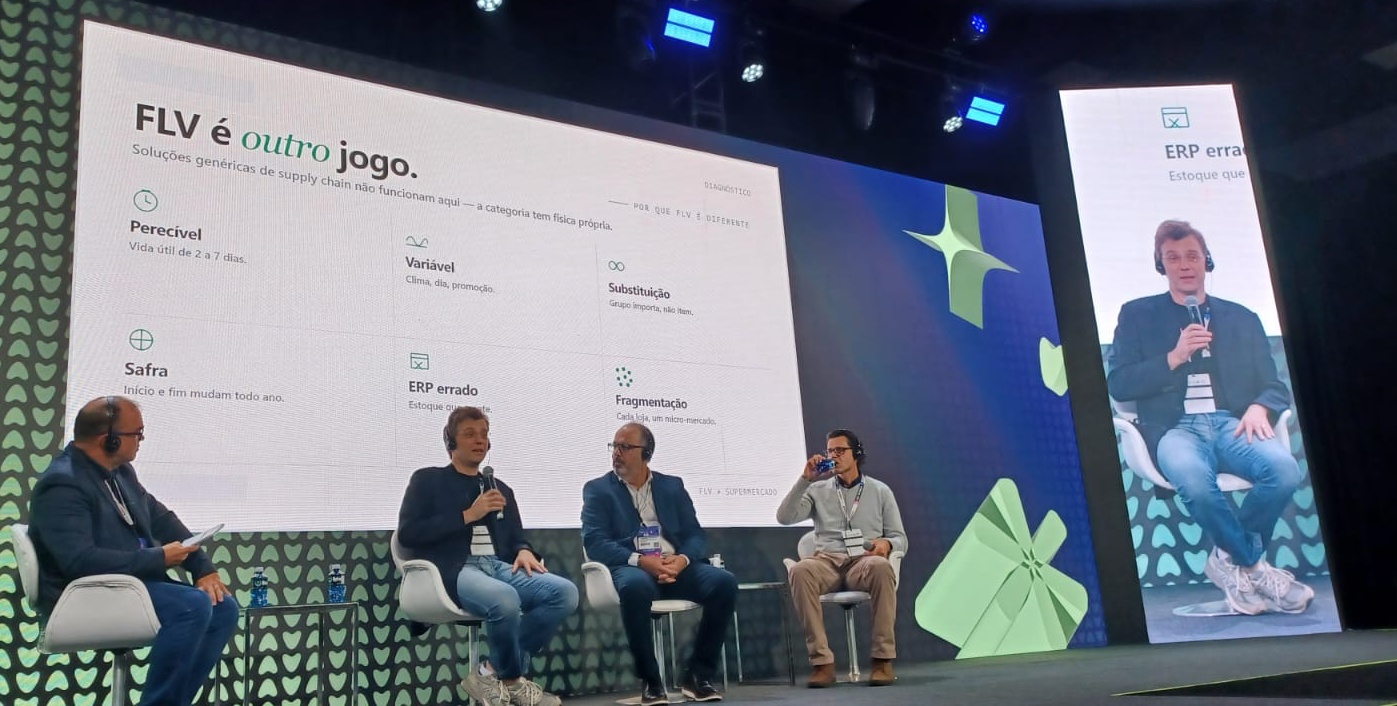
The production of the FFLVO [Fruits, Flowers, Vegetables, Greens and Eggs] segment is led by family farming. Small-scale producers naturally work on a small scale. Therefore, to make their operation viable, they need to seek differentiation. In this agenda, investing in adding value to the product [by processing it, obtaining certifications, i.e., decommoditizing it]; developing a brand; forging partnerships; and using creativity at the point of sale are strategies to attract the consumer's attention in retail. This was the scenario outlined by experts during the "IFPA Forum – FFLVO for Supermarkets", promoted by the International Fresh Produce Association (IFPA), at APAS Show 2026, which ended last Thursday (21), in São Paulo. Representing the egg segment, Guilherme Armanhe, owner of the Label Rouge brand, said that the "secret" of his business was to bet heavily on differentiation. "To avoid competing on price, we invested in a quality product, the free-range egg, which has a bright red yolk, a more consistent white, and less odor than the traditional white egg," he emphasized. This journey, the executive added, also involved the management of the chickens [raised free-range, not in cages, in a practice of animal welfare]; as well as the use of formats and packaging different from the market standard [ten units, not a dozen, in colorful packages, moving away from the common cardboard containers]. "We moved from commodity eggs to working in a high-value niche," he pointed out. José Eduardo Carmagnani then recounted the case of Zespri Brasil – an importer of kiwis – but in an example that can work – and work well – for national family farming. The brand representative discussed a marketing campaign that was based on a packaging model reminiscent of vitamin tablets sold in pharmacies. "With this format, we wanted to show that the vitamin C the consumer needs is naturally present in the fruit, which was packaged as if it were a vitamin capsule. After this action, more than 60% of consumers began to recognize the brand by its packaging, reinforcing the role of branding in the segment." In the flower shop, Simone van Oene, from Joost Kalanchoe, highlighted the need to transform flowers into a sellable category throughout the year, using point-of-sale organization and emotional communication to generate a connection with the consumer. She advocated for the regionalization of the calendar, with secondary dates – in addition to the flagship dates like Women's Day and Mother's Day. "That's what we did, for example, with the Farroupilha Revolution holiday in Rio Grande do Sul, where we connected the date with flowers." In a debate moderated by the director of GS1 Brazil, Nilson Gasconi, who recalled the importance of tools dedicated to origination and traceability, with emphasis on barcode technology, Rafaela Fava, from Bananas Fava, also recalled… The market increasingly demands that retail buyers have firsthand knowledge of the realities and specificities of agricultural production.
This text was translated by machine from Brazilian Portuguese.