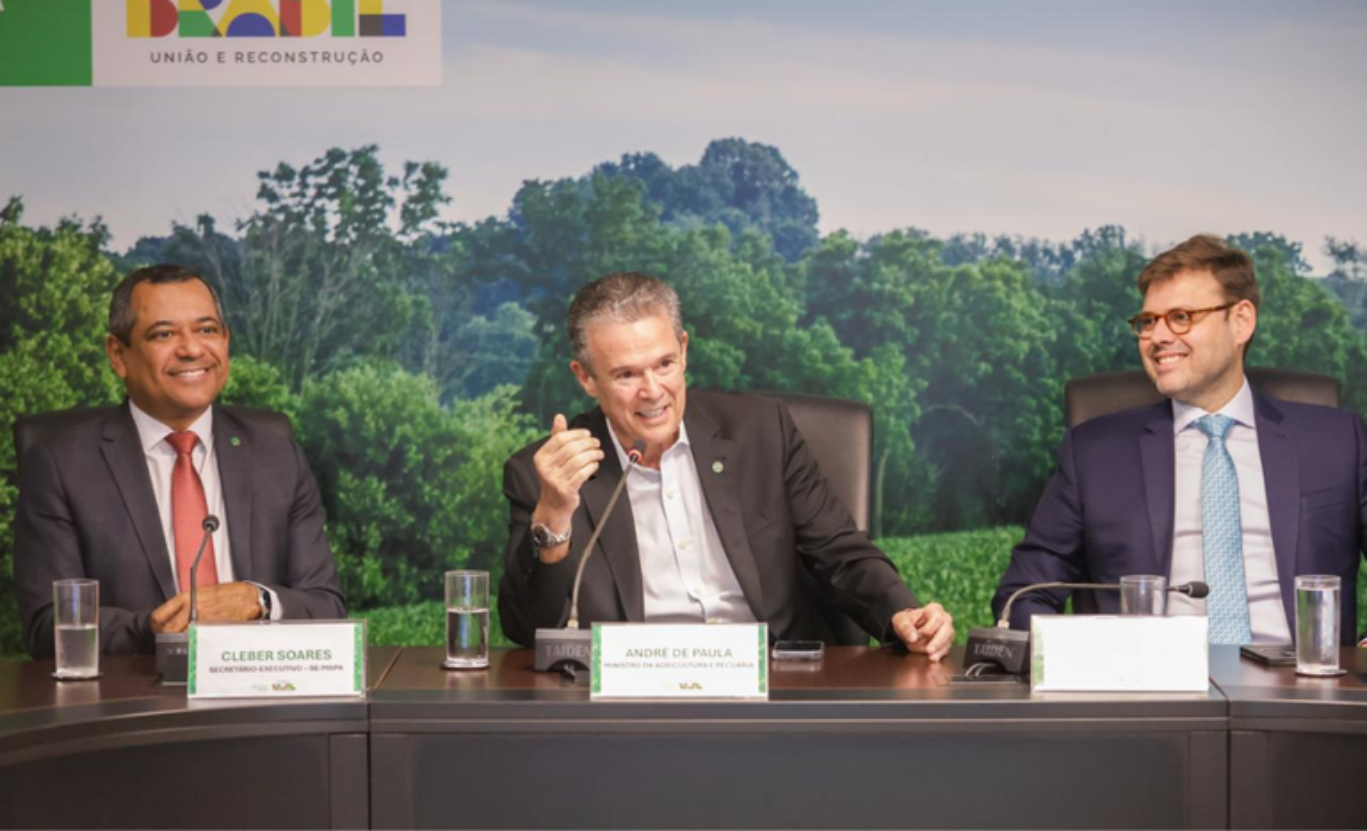
On Tuesday (23), the Minister of Agriculture and Livestock, André de Paula, signed the decree establishing the Brazil-Bolivia-Pacific Productive and Logistics Integration Program. The initiative establishes strategic guidelines to promote productive, agro-industrial, logistical and commercial integration between Brazil, Bolivia and the Pacific markets, within the scope of the Ministry of Agriculture and Livestock (Mapa). The program aims to increase logistical efficiency, reduce transport costs and strengthen the international insertion of Brazilian agribusiness. Among the goals are adding value to primary production, stimulating regional development and attracting investments in infrastructure and foreign trade. The measure enables the flow of national agricultural production through logistical corridors that cross Bolivian territory to the ports of the Pacific Ocean, configuring a strategic alternative to traditional export routes. With this, Brazilian products gain greater agility and competitiveness in Asian and Pacific region markets. During the ceremony, Minister André de Paula highlighted the importance of agribusiness to the Brazilian economy and the leading role of Mato Grosso in national production. “When we talk about agriculture, we need to recognize the leading role of the state of Mato Grosso, which is responsible for about 35% of everything we've discussed here. It's wonderful to know that a simple act, crowning a series of efforts, is so important in reducing distances, reducing costs, and enabling access to this very promising market,” he stated. The General Coordinator of Cooperativism, Rural Associations, and Value Aggregation at the Ministry of Agriculture, Nelson Andrade, explained that the initiative is structured around four pillars: support for infrastructure and logistics; regulatory and international trade facilitation; technical and sanitary cooperation; and commercial promotion with investment attraction. These pillars guide actions aimed at valuing production, attracting investment, and increasing the competitiveness of Brazilian agribusiness. For Mato Grosso, the program represents a strategic opportunity with a high impact. As the largest agricultural producer in the Midwest and a border state with Bolivia, Mato Grosso could directly benefit from the consolidation of cross-border road corridors, especially with the integration of sections such as the MT-199 highway. This connection strengthens the potential of western Mato Grosso as an access route to the Pacific, contributing to the reduction of distances and logistical costs in the transportation of grains, meat, and other agricultural products. The corridor could also benefit other states in the Midwest and North regions by offering a logistical alternative for the flow of production. On the Bolivian side, the initiative contributes to infrastructure development, the strengthening of bilateral trade, and regional integration. The former executive secretary of the Ministry of Agriculture, Livestock and Supply (MAPA), Irajá Lacerda, recalled that the program is the result of work initiated in 2024 and consolidated in the current administration. "Today marks the culmination of many years of work. For three years and three months, we engaged in dialogue with all ministries and sectors to demonstrate that the western border of Mato Grosso and the border between Brazil and Bolivia needed to be seen as an integration zone," he stated. The president of the Brazil-Bolivia Integration Committee in the State of Mato Grosso, Pedro Panoff de Lacerda, congratulated Minister André de Paula on signing the decree. "I want to congratulate Minister André de Paula on the consolidation of this productive and logistical integration program, which represents exactly what our region needs to strengthen integration with Bolivia and the Pacific. This closer route is a dream for the state of Mato Grosso," he said. The president of the Federation of Agriculture and Livestock of the State of Mato Grosso (Famato), Vilmondes Tomain, highlighted the positive impacts on regional development. "This integration will shorten routes and develop a region that has fantastic lands and strong agriculture. This corridor that is now opening up to western Mato Grosso will certainly improve competitiveness and bring benefits in every way," he stated. The program also foresees the carrying out of technical studies, the elaboration of strategic recommendations, inter-institutional coordination, and continuous monitoring of actions. Its execution may involve national and international public-private partnerships. The operationalization will be regulated by the Executive Secretariat of the Ministry of Agriculture, Livestock and Supply (MAPA), with the creation of a Management Committee by decree of the minister. The initiative represents another step in MAPA's strategy to diversify logistics corridors, strengthen the competitiveness of Brazilian agribusiness, and expand access for national production to international markets.
This text was translated by machine from Brazilian Portuguese.