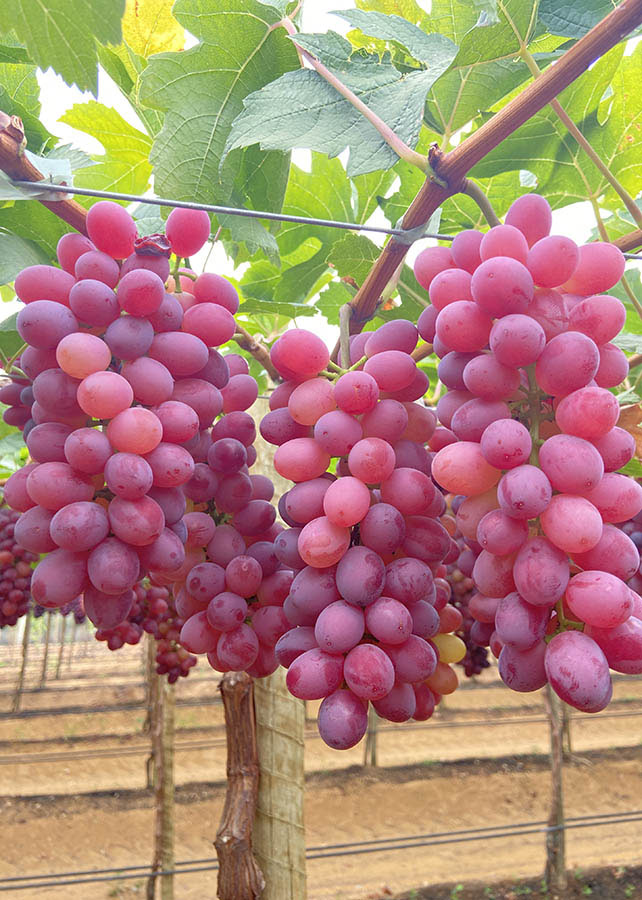
The São Francisco Valley was the stage, this Friday (22), for a watershed moment for Brazilian fruit growing. Producers, public authorities and sector leaders met at the Valexport Auditorium, in Petrolina (PE), for the Fruits Caravan – From the Valley to the World. The event marked the institutional registration of the first shipment of fresh grapes with zero tariff destined for the European Union. The official opening ceremony was attended by the Minister of Agriculture and Livestock, André de Paula; the president of ApexBrasil, Laudemir Müller; the president of ABRAFRUTAS, Waldir Promicia; and the president of CropLife Brasil, Ana Repezza. Also present at the meeting were the mayor of Lagoa Grande (PE), Catharina Garziera; the Secretary of Agrarian Development, Agriculture, Livestock and Fisheries of Pernambuco, Cícero Moraes; the federal deputy Fernando Monteiro; the vice-mayor of Petrolina, Ricardo Coelho; and the president of the Board of Directors of Embrapa (Consad), Guilherme Coelho.
Billion-dollar market
The opening of the European market without tariffs places Brazil before a commercial ecosystem of gigantic proportions. The president of ApexBrasil, Laudemir Müller, presented macroeconomic data illustrating the size of the opportunity and recalled the successful trajectory built over the last decade through the partnership with the Brazilian Association of Fruit and Derivative Producers and Exporters (ABRAFRUTAS). "Europe imports 7 trillion dollars; from outside the bloc alone, that's 3 trillion dollars. Mercosur imports 342 billion. So it's in this market that we're going to enter without tariffs. Some faster, like grapes, which are already tariff-free, and others that will have tariffs reduced later. Fruit farming will be one of the biggest beneficiaries. When we started the partnership between ApexBrasil and Abrafrutas in 2014, Brazil exported 413 million dollars worth of fruit. Last year we exported 1 billion and 450 million. In 10 years, we brought an additional 1 billion dollars to Brazil from this fruit farming sector," Müller highlighted.
A historic achievement
The elimination of the import tariff was highlighted as the result of a long-term inter-institutional effort. During the ceremony, Minister André de Paula emphasized the importance of this achievement for the regional economy, noting the direct impact on the pockets of producers in the Northeast. "This is the struggle of many people who believed it was possible. And this agreement will benefit approximately 5,000 items, the vast majority of which come from the agricultural sector. A very clear example, and this is something that is already happening from the very first moment, is our grapes, which were previously taxed at 12% and will now have a zero tax rate. This makes a difference when we know that 75% of what we export here goes to Europe. We will now export without this burden, with better competitive conditions and a greater return for the producer," the minister stated.
Green technology and bio-inputs as an international passport.
To sustain the growth rate and meet the stringent food safety and ESG criteria of the European bloc, the Fruit Caravan also hosted in-depth technical debates on technological innovation. Ana Repezza, president of CropLife Brazil, presented significant data that consolidates Brazil as the leading global power in sustainable management and the application of biologicals, a reality very present in local horticulture. "Brazil is currently the country that most adopts bio-inputs in its crops, with a 21% growth in adoption compared to 2024. This is a market that generated R$ 6.2 billion in 2025 with a 28% growth in the treated area. There are 194 million hectares treated with bio-inputs in Brazil, and a large part of this area is dedicated to fruit growing." With the zero tariff consolidated and an increasingly clean and innovative production matrix, the expectation of the organizing institutions is that the São Francisco Valley will expand its participation in the international market, generating more jobs, income, and development for the entire ecosystem of Northeast Brazil.
This text was translated by machine from Brazilian Portuguese.